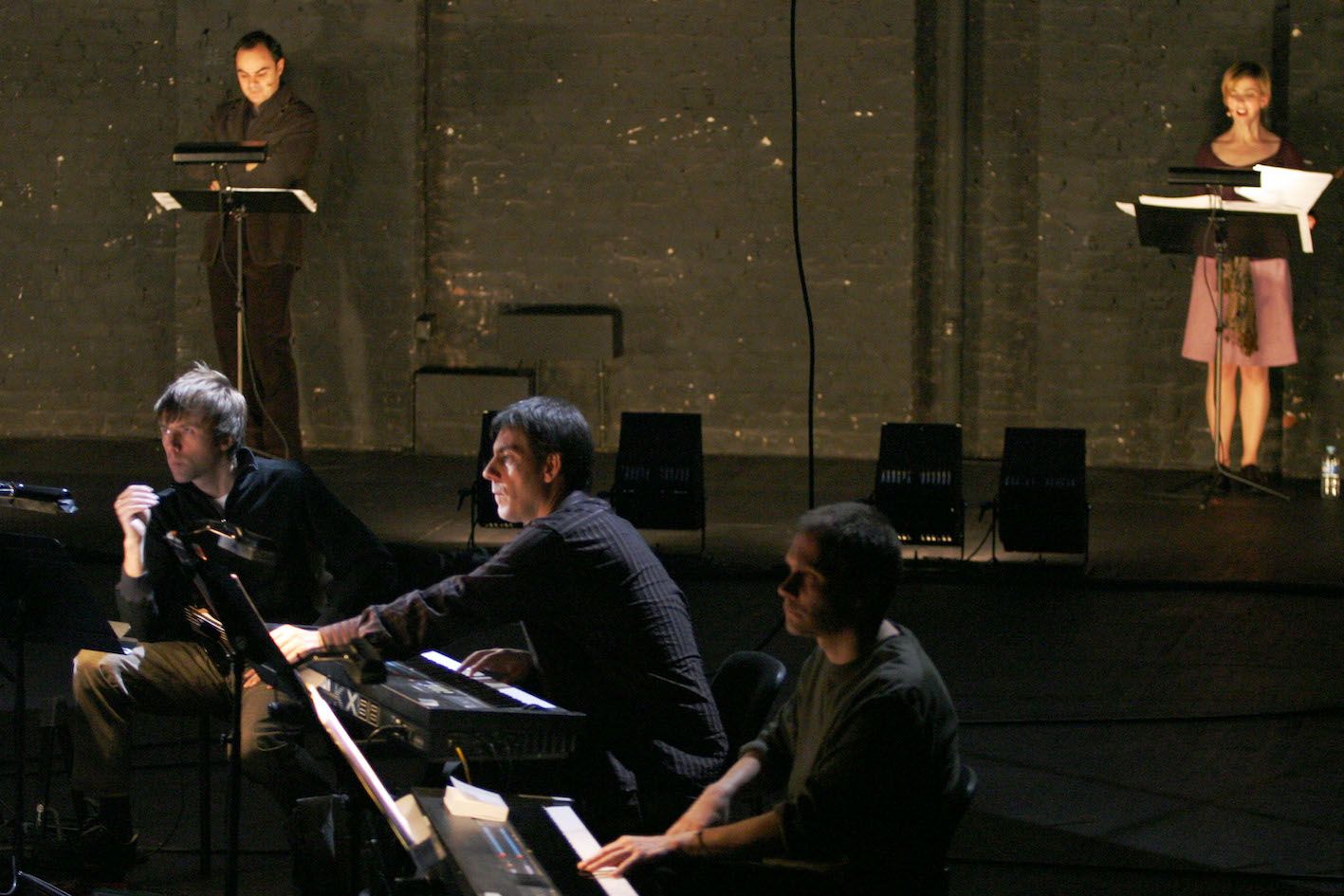
Avis de Tempête
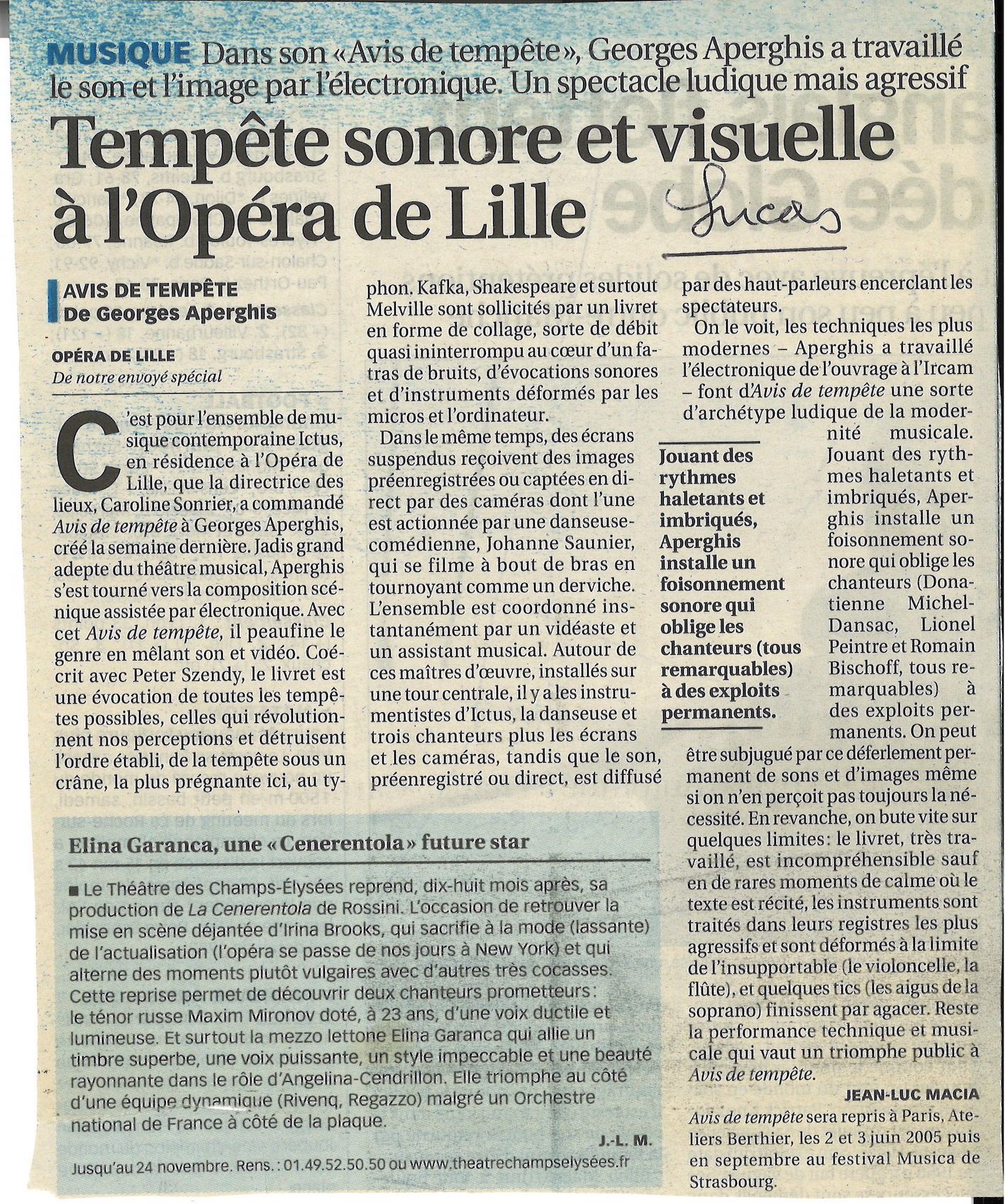
An opera by Georges Aperghis, 2004
Music and direction: Georges Aperghis
Libretto: Georges Aperghis and Peter Szendy, including fragments of texts by Herman Melville, Franz Kafka, Charles Baudelaire, William Shakespeare, Victor Hugo
Conductor: Georges-Elie Octors
Donatienne Michel-Dansac: soprano | Johanne Saunier: actress and dancer | Lionel Peintre: baritone | Romain Bischoff: baritone
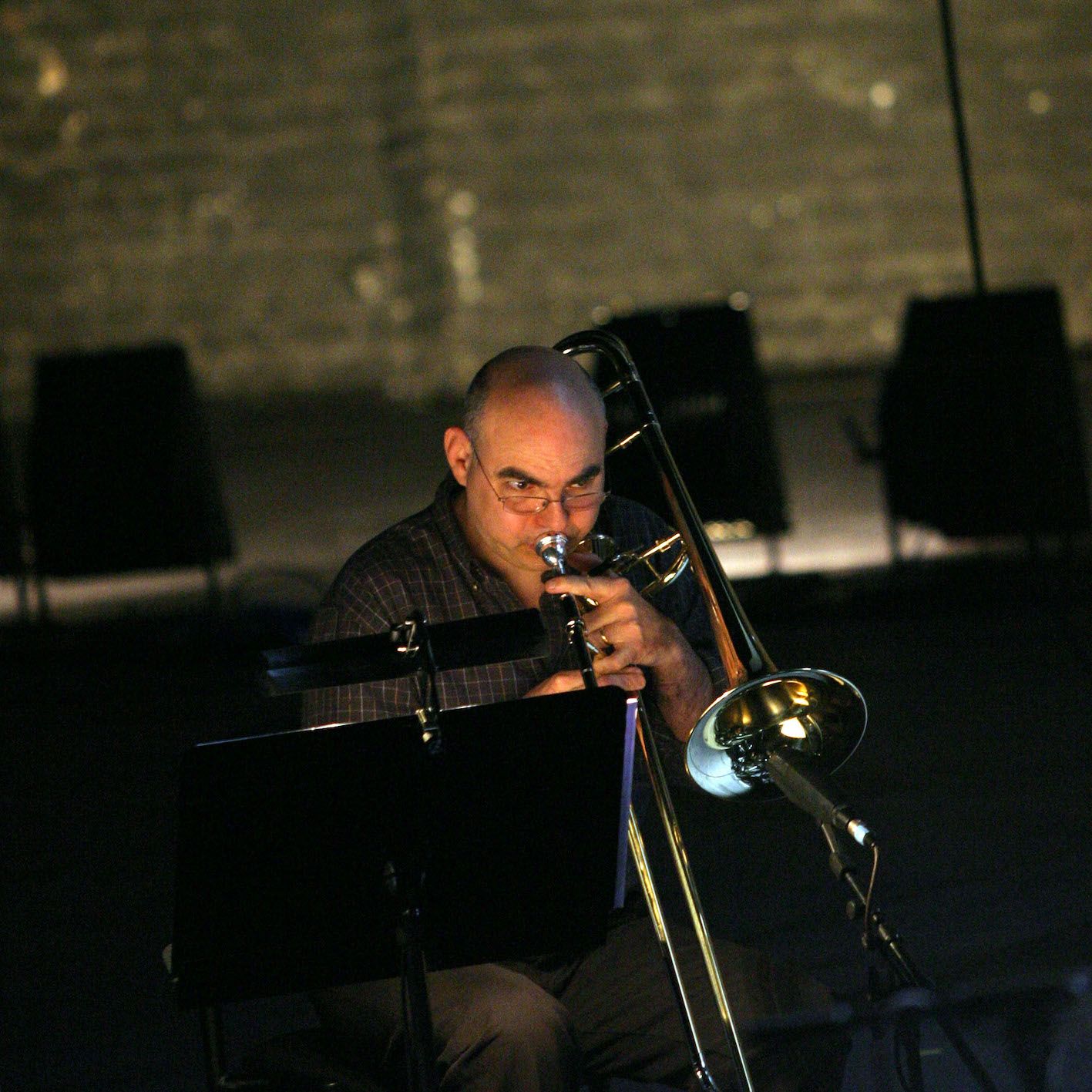
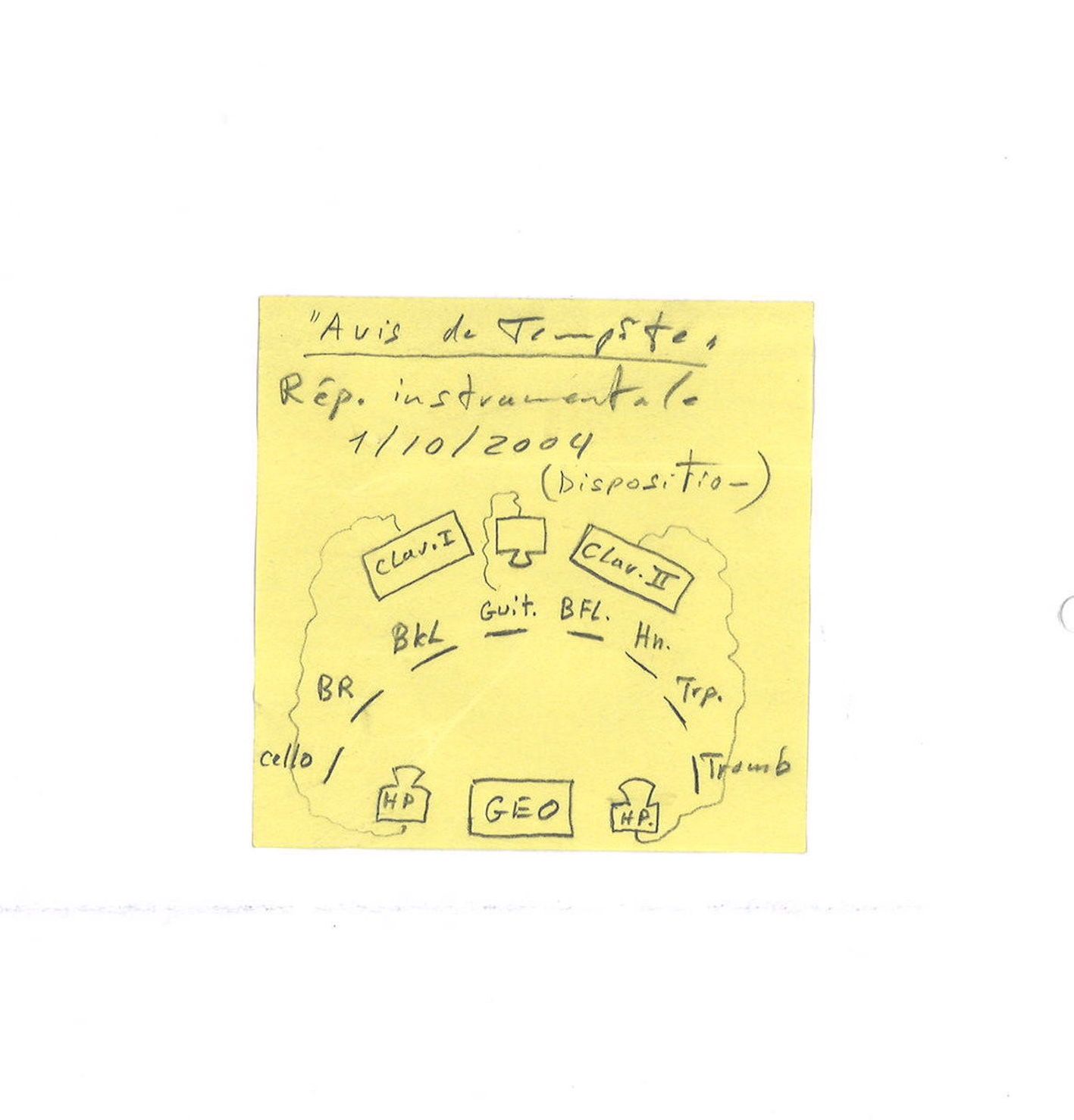
Ictus — Kaatje Chiers: horn, Paul De Clerck: viola, François Deppe: cello, Dirk Descheemaeker: bass clarinet, Jean-Luc Fafchamps: keyboard; Tom Pauwels: electric guitar, Alain Pire: trombone, Jean-Luc Plouvier: keyboard, Philippe Ranallo: trumpet, Michael Schmid: flutes
Computer music design IRCAM: Sébastien Roux | Video: Kurt d’Haeseleer - de filmfabriek | Stage and light design: Peter Missotten -de filmfabriek | Music software: IRCAM | Sound: Alexandre Fostier | Direction assistant: Emilie Morin
Excerpt from the Kaaitheater program, 2007
One of the high points of last season was the performance of Georges Aperghis’ 14 Récitations by the French soprano Donatienne Michel-Dansac during the Performatik 3 festival. (...) Aperghis is joining us again this season, and again with Avis de tempête, according to Les Inrockuptibles a ‘miraculous, hallucinatory’ piece of musical theatre, first performed by Ictus at the Opéra de Lille in 2004. It was staged by Aperghis himself. Both on stage and in his score, Aperghis unleashes a storm that sweeps away everything in its path. In the script he mixes Melville’s Moby Dick with extracts from Kafka, Baudelaire, Shakespeare and Victor Hugo. But, just as in the 14 Récitations, the words are not set to music, the words are music. The words intensify the musical high. For the singers it is a tour de force in which they are assisted by ten musicians and the ingenious use of video and stage setting (created by the FilmFabriek).
In this opera, singing, acting, music, electronics, video, light and stage set are forged into a single whole. As Le Figaro put it: ‘It is the perfect combination of all means of expression that makes Avis de Tempête a total work of art."

Score follower
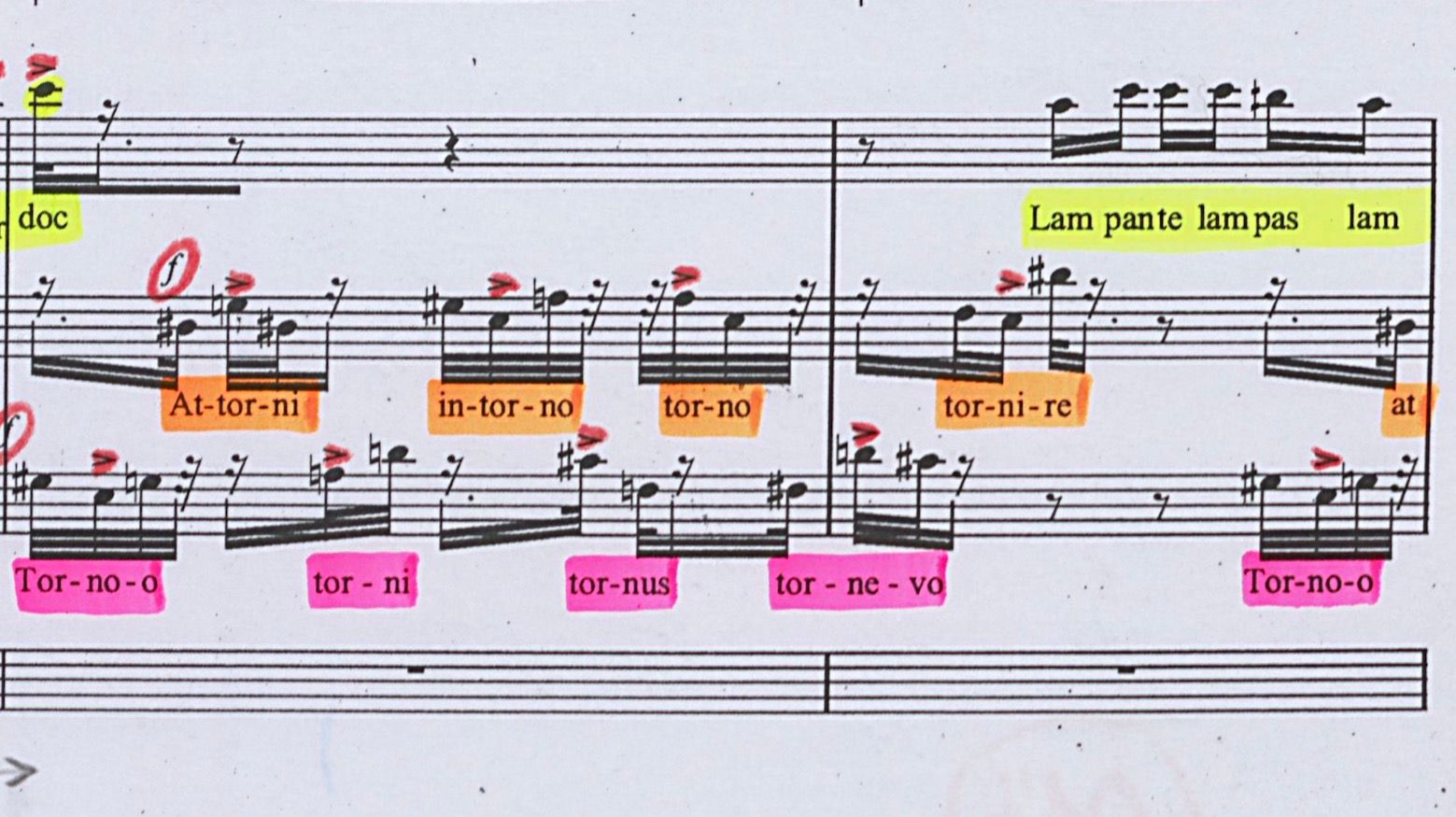
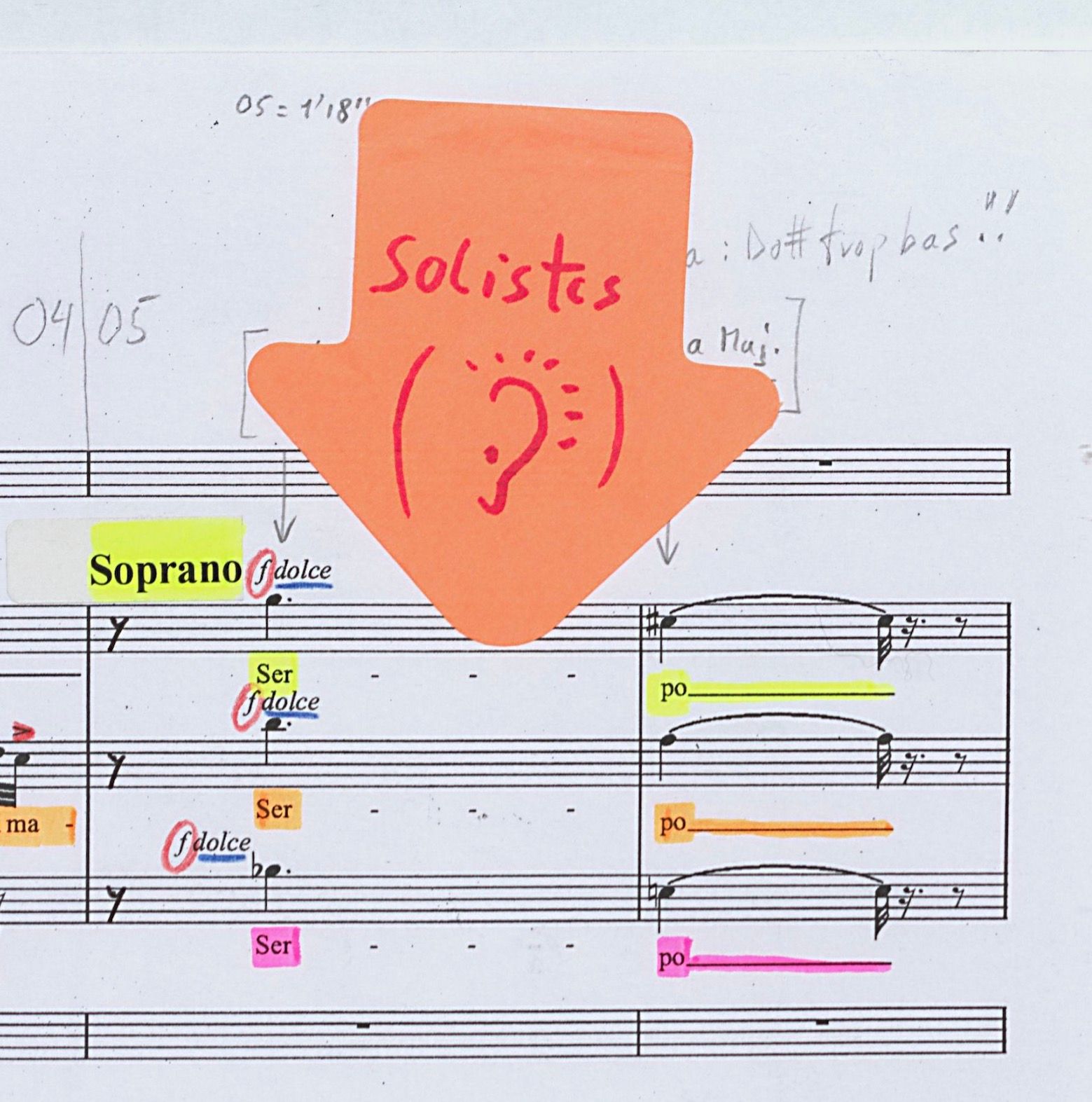
This video has been edited from the original personal score of Georges-Elie Octors.
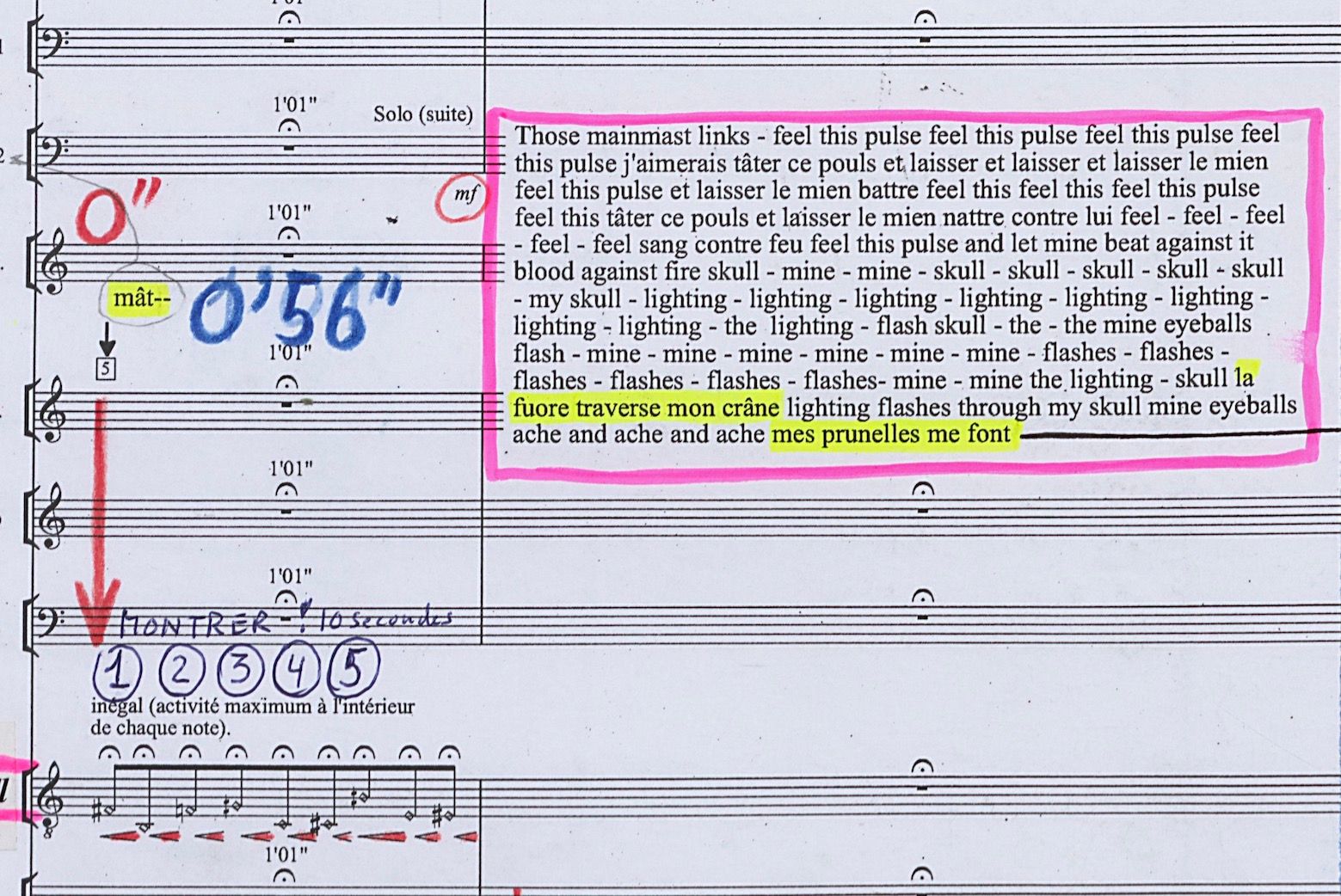
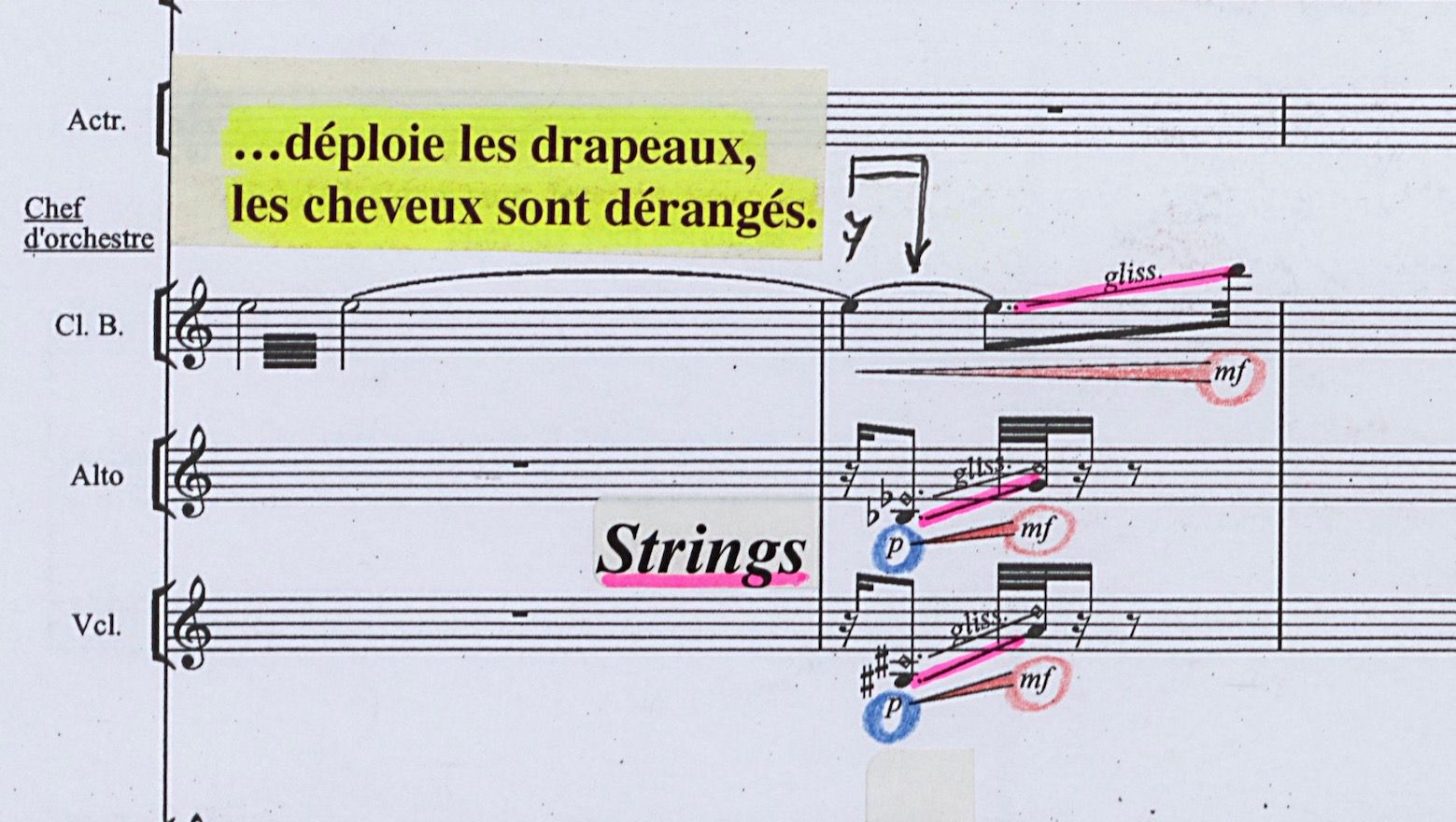
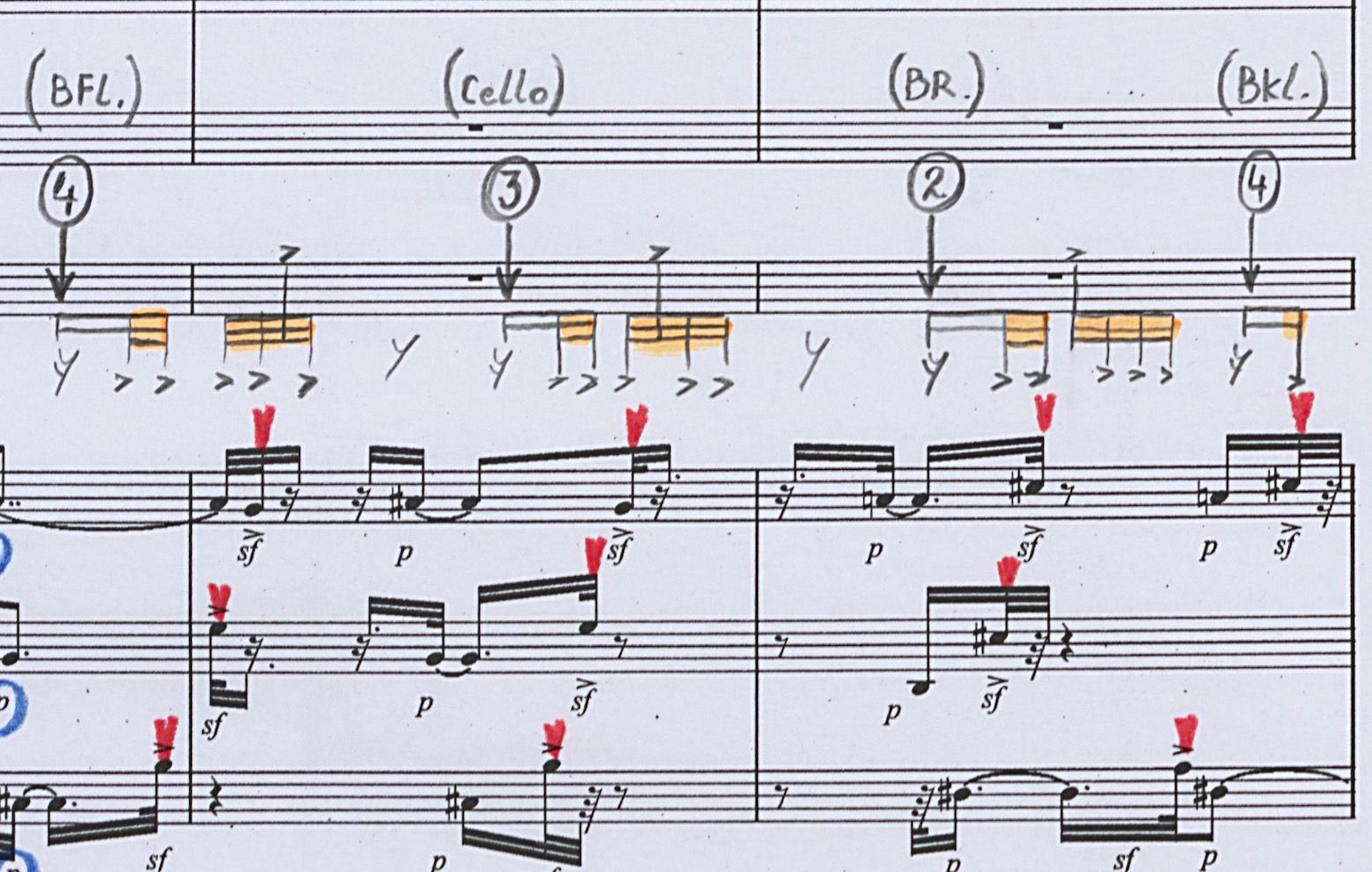
Avis de tempête: libretto, credits, video & notes
The booklet is available on our website at this address
Full credits and CD sleeve notes are available on this page.
For documentary purposes, the full video of the concert (low quality) is available here
"Aperghis, tempête sous un crâne"
Documentary directed by Catherine Maximoff
Aperghis, tempête sous un crâne (Storm Beneath a Skull)
Documentary directed by Catherine Maximoff
Written by Patrice Nezan and Catherine Maximoff
Episode specifically dedicated to Avis de tempête at 39:42
Video from the Vimeo page of the director.
France • 2006 • 59 minutes
Les Films du présent
From the CD booklet
Before writing a single note of his opera Avis de Tempête (Storm Warning), Georges Aperghis had given the watchword to his collaborators, the librettist, the video artists, the singers, the computer technician, the conductor, the scenographer and the musicians: “an opera that is a storm”. Here are a few fragments of what has been noted down since then.
(GEORGES APERGHIS) ...storms... Construct – relate. Then disturb – erase. Storm in the mind, in the text, in the music. The instruments, the voices, the electronic sounds write, erase, write, erase, in turn, like some vast breathing process. Like a story forever beginning again. The main part of the spectacle troubled by internal disturbances. Moby Dick, King Lear, The Lightning-Rod Man: allegories of the mental storm that rips through the text and subverts the spectacle from within. Immobile storms too. A kind of novelty of our century. Vertical storms – almost calm – much more terrifying than countryside thunder.
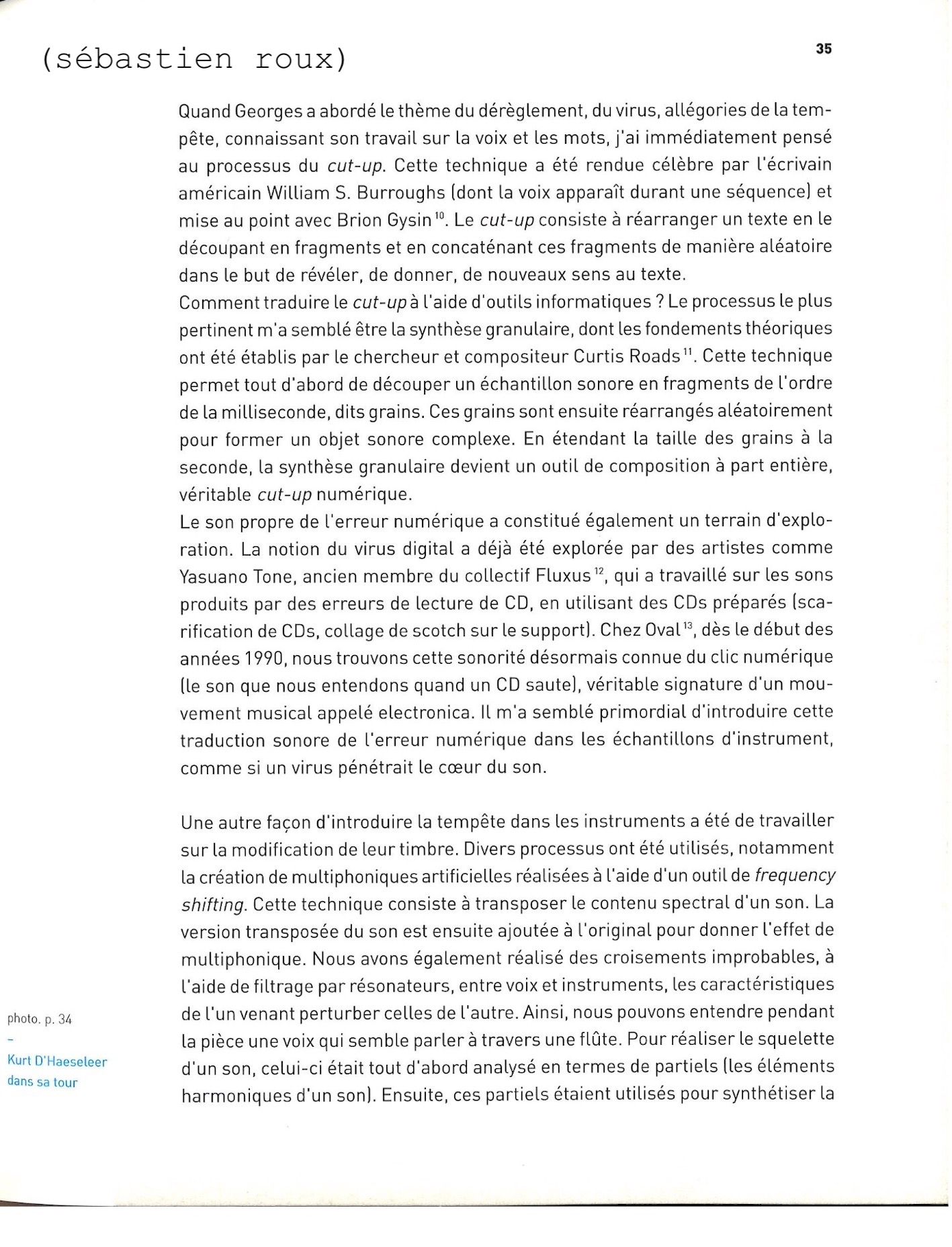
(SÉBASTIEN ROUX) ...electronic cut-ups... When Georges Aperghis tackled the theme of dysfunction, of the virus – allegories of the storm – and knowing of his work on the voice and on words, I at once thought of the process of cut-up. This technique, made famous by the American writer William S. Burroughs (whose voice appears in one sequence!), had been developed by the latter and by Brion Gysin. The cut-up consists of reordering a text by cutting it up into fragments and randomly linking these fragments together again with the aim of revealing or giving new meanings to the text. How can a cut-up be effected with the tools of computing? The most pertinent process seemed to me that of granular synthesis, the theoretical foundation of which has been established by the researcher and composer Curtis Roads. This technique entails cutting up a sound sample into fragments that last a matter of milliseconds, the so-called grains. These grains are then randomly reordered to form a complex sound object. By extending the size of the grains to one second, the granular synthesis becomes a fully fledged compositional tool, a truly digital cut-up.
(PETER SZENDY) ...whale-text... What could I answer when he said to me (it was three years ago) that he would like something for a forthcoming spectacle on the storm? On the storms, all storms? And how did that word canvas come about, the one we have become accustomed to calling, between ourselves, our whale-text? As regards my contribution (before he reintroduced loops, repetitions, sculpted syllables and phonemes, even scattered fragments of texts garnered from here and there, from Kafka, Shakespeare et al.), here is what happened. Like Sheherazade, for whom the future depended on a continuing succession of stories, a voice – that of a narrator – speaks to you. This voice does not invent fiction with which it tries to converse with you and hold you: it manipulates it, it borrows it (mainly from Melville) and it adds endless commentaries. It reiterates its glosses, all of which deal with reading, with the act of reading as an opening out to a prophecy or to a future promise, like exposure to an improbable, unpredictable and ‘unprereadable’ event, the figure of which is the storm and its various forms (thunder storm, cyclone, flood, etc.).
(GEORGES APERGHIS) ...from one world to another... Fluids, sounds, images, information: they all pass through us and it becomes very difficult to focus on any one thing. Electronics enables me to realise this state of perpetual transition, to jump from one world to another. An abstract sound becomes the voice of an actor, a phoneme becomes running water, a character may be divided up and then reconstructed elsewhere. I work on two electronic worlds, a harmonic world built on distorted octaves and a world of very low level noises progressively amplified until they swamp everything. The electronics is there to destabilise the ensemble but also to sweep it away as a real storm would, to outstrip it, to catch it unawares. Compared with the storm everything becomes small and ridiculous.
(PETER SZENDY) ...in the flood... Among the fragments read, interpreted and translated by this voice, two narratives by Melville act as golden threads that crisscross as they interact and entwine each other: the short story entitled The Lightning-Rod Man and the great novel Moby Dick. In the story, the one who speaks and who says “I” holds not only the text of an unfolding storm, but also, within himself, a focus of intrusion that flows back towards him and enrages him: dislodged in the deluge. From the novel, on the other hand, come many scenes representing a reading of the novel as a drifting, a loss of anchorage, a splitting, in which, paradoxically, prediction and presage are achieved by breaking the horizons of expectancy, to the point that, since everything has already happened and there is nothing more to verify, the event seems to have free range: it starts up again, as if the Leviathantext, infinitely reworked and glossed, had let a bubble escape from itself. The result is repetition, that is to say the unheard of.
(GEORGES-ÉLIE OCTORS) ...to be grasped... An incredible characteristic of Georges Aperghis’s works, and one that is ever a surprise, is the contrast between the limpidity of the score and the lively, organic profusion of the musical result. In opening a score by Georges, you feel you can smell the wooden desk at which it was patiently written, note by note, in his tight, fastidious hand. The simplicity, the transparency, the rigor might have presented the performer with frightful constraints; but nothing of the kind: the score is laid out in such a way that the musician can grasp it as a whole, and everything motivates him to give it life. And the basic reason for this is that his style, even at its most idiomatically instrumental, is first and foremost and fundamentally vocal.
(SÉBASTIEN ROUX) ...spectrums and skeletons... this opera is a mixed work, comprising an acoustic part for instruments and voices and an electronic part. This latter consists of sequences, the development of which preceded the instrumental score which thus came to be enriched with the electronic material. The sequences, set off in the course of the work, act like punctuation marks in the score, like a counterpoint to the orchestra as touching both tone-colour and space. With a view to translating the storm of the mind through the electronic medium, Georges Aperghis’s idea was to apply to samples of instruments or voices transformations able to indicate dysfunction. Georges thus established a list of themes for research, poetic evocations of algorithms: virus, skeleton, tone-colour enrichment, the notion of vertical, of octave, of harmonic add-on. I based myself on this vocabulary in order to make some computer tools, storm machines, a personal interpretation of the main lines proposed by Georges Aperghis.
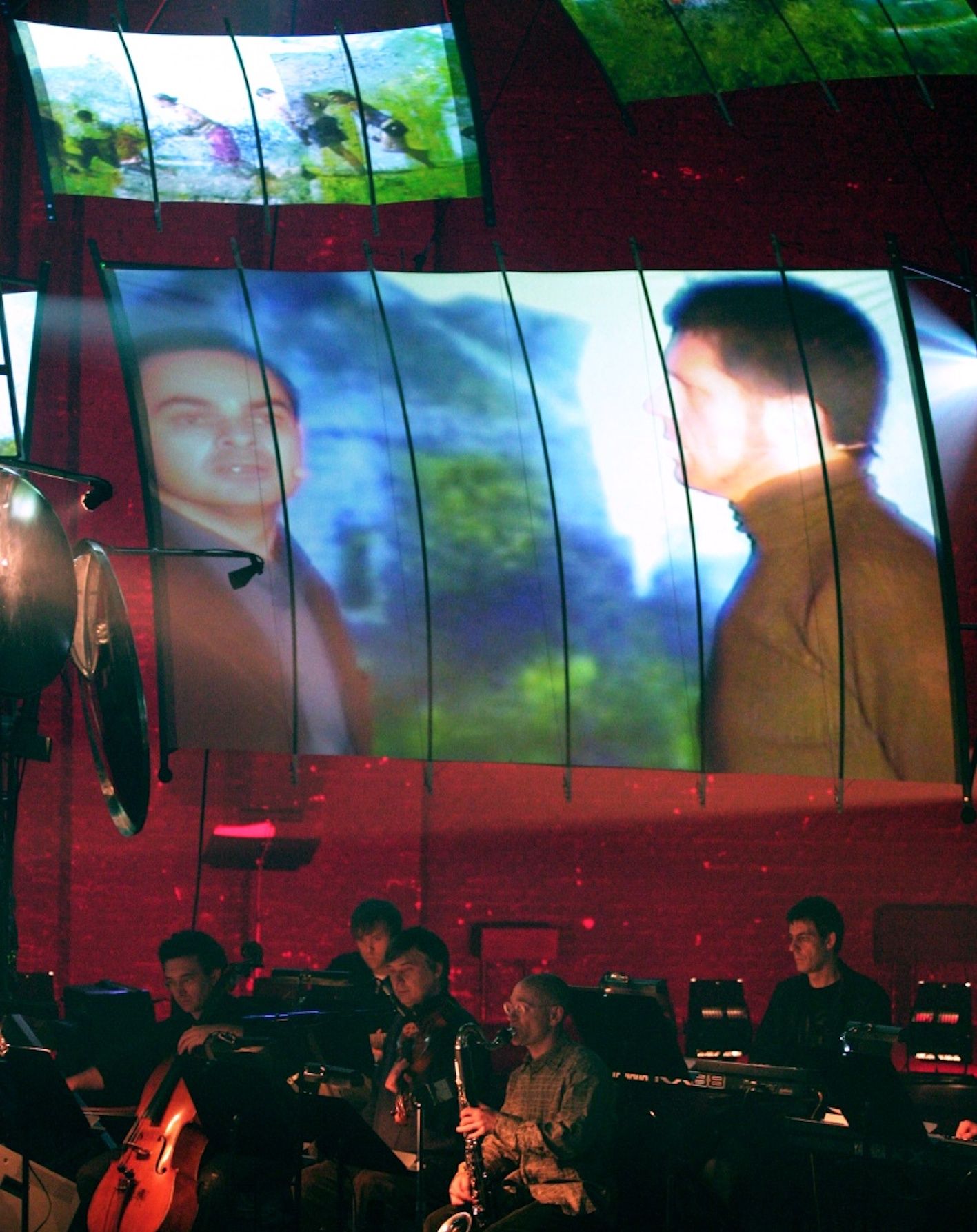
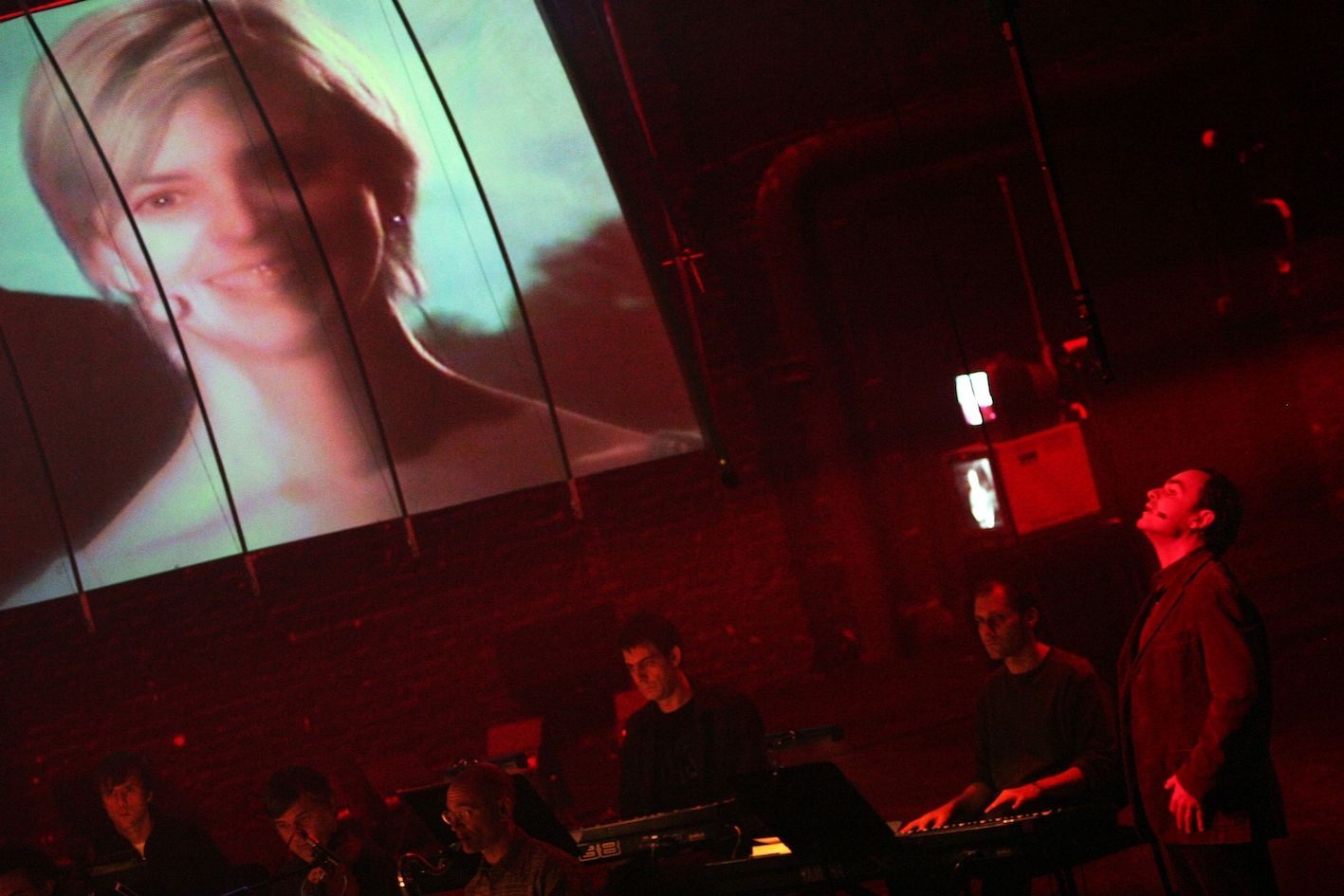
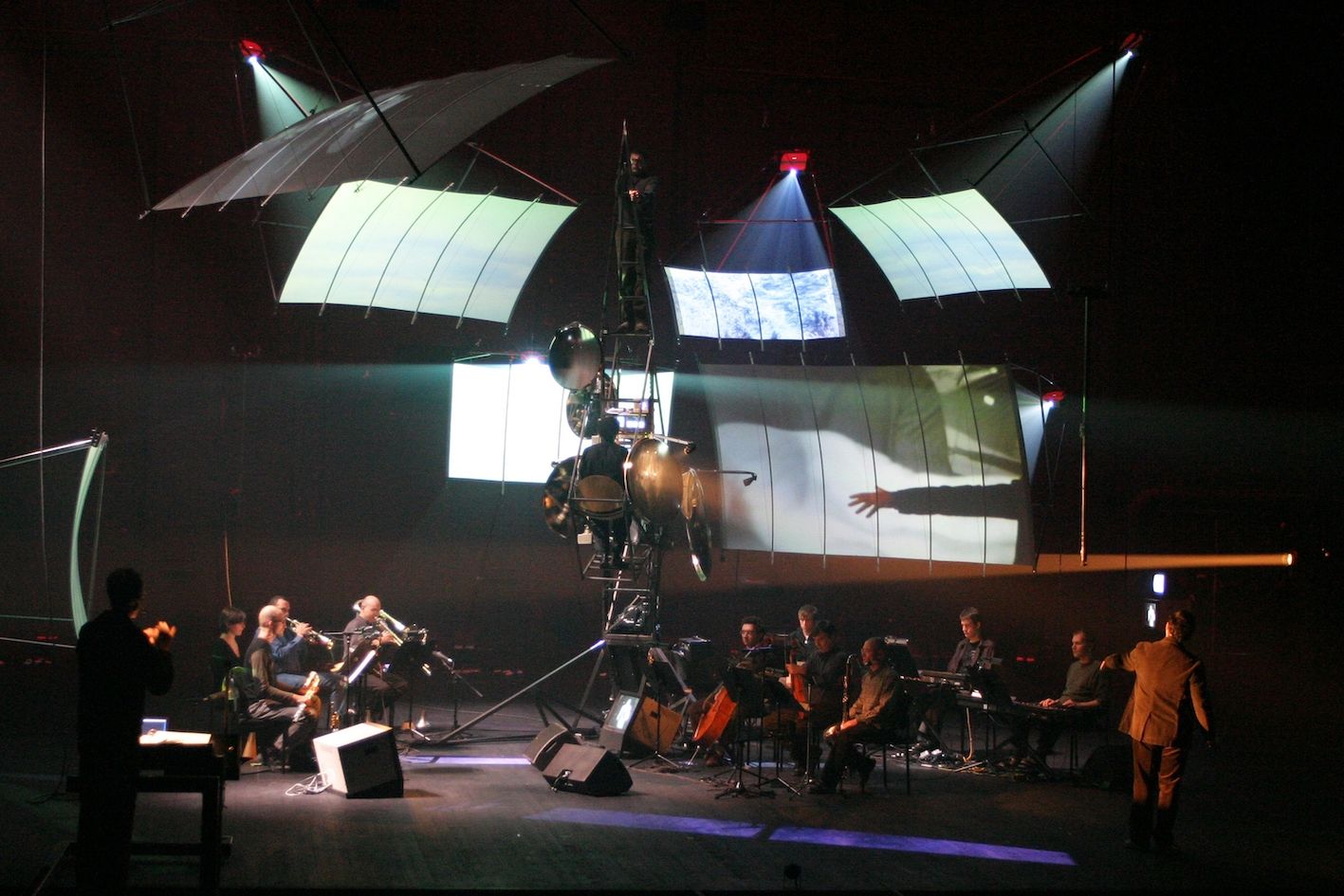
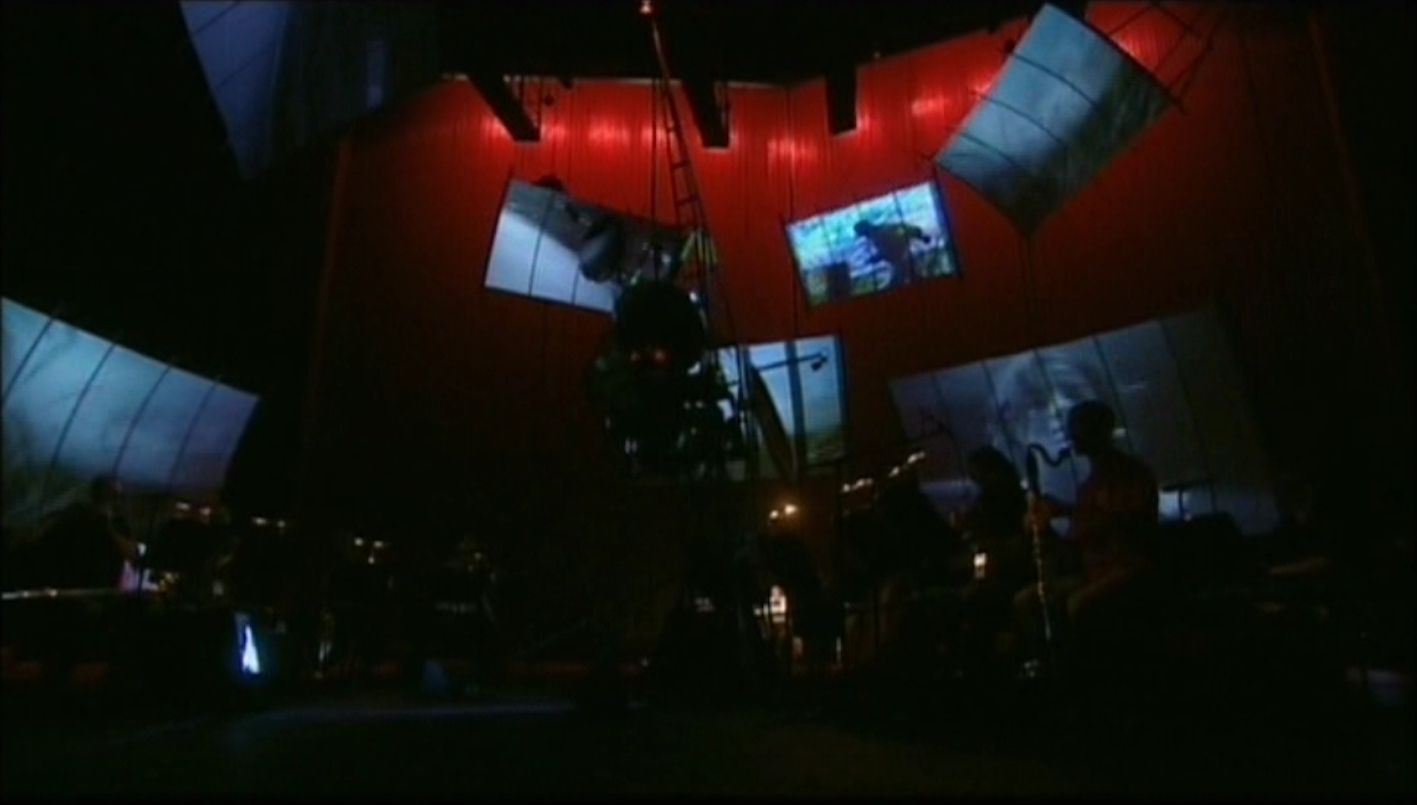
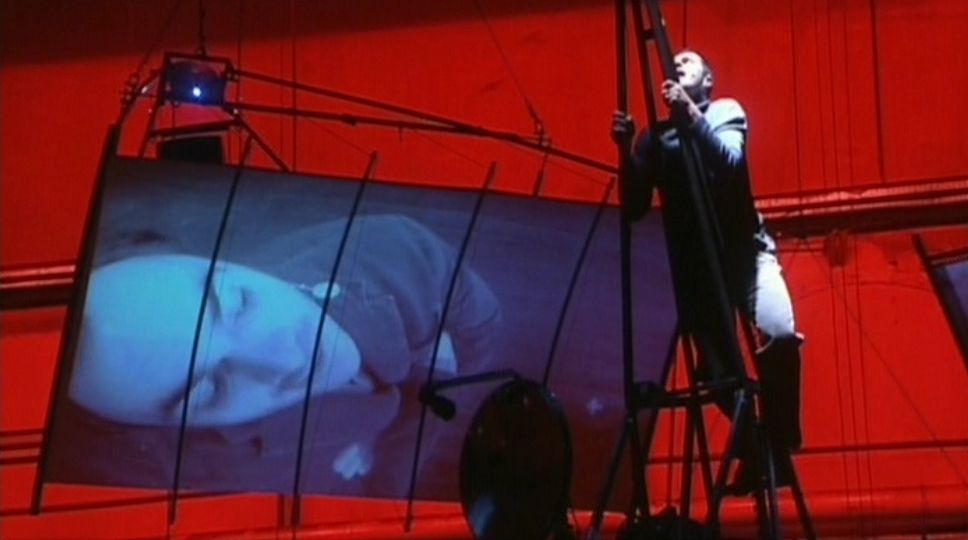
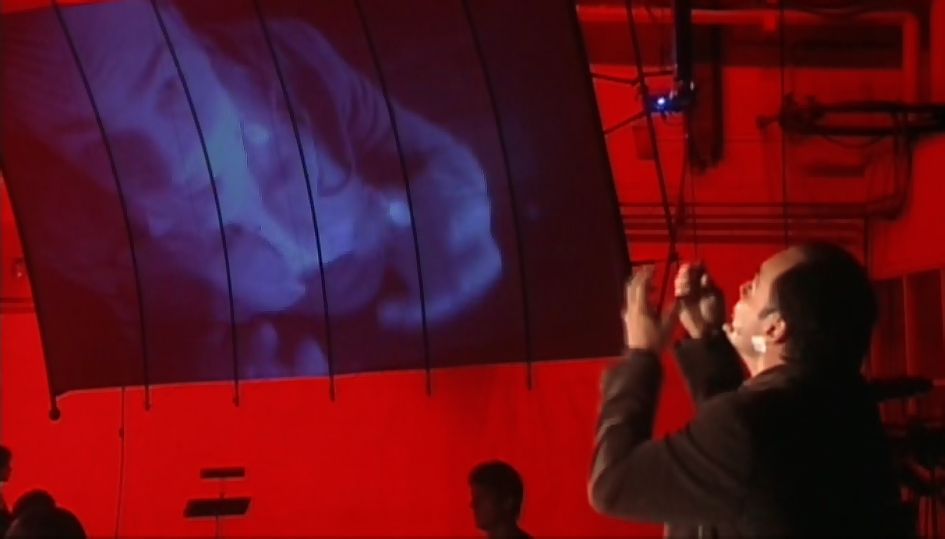
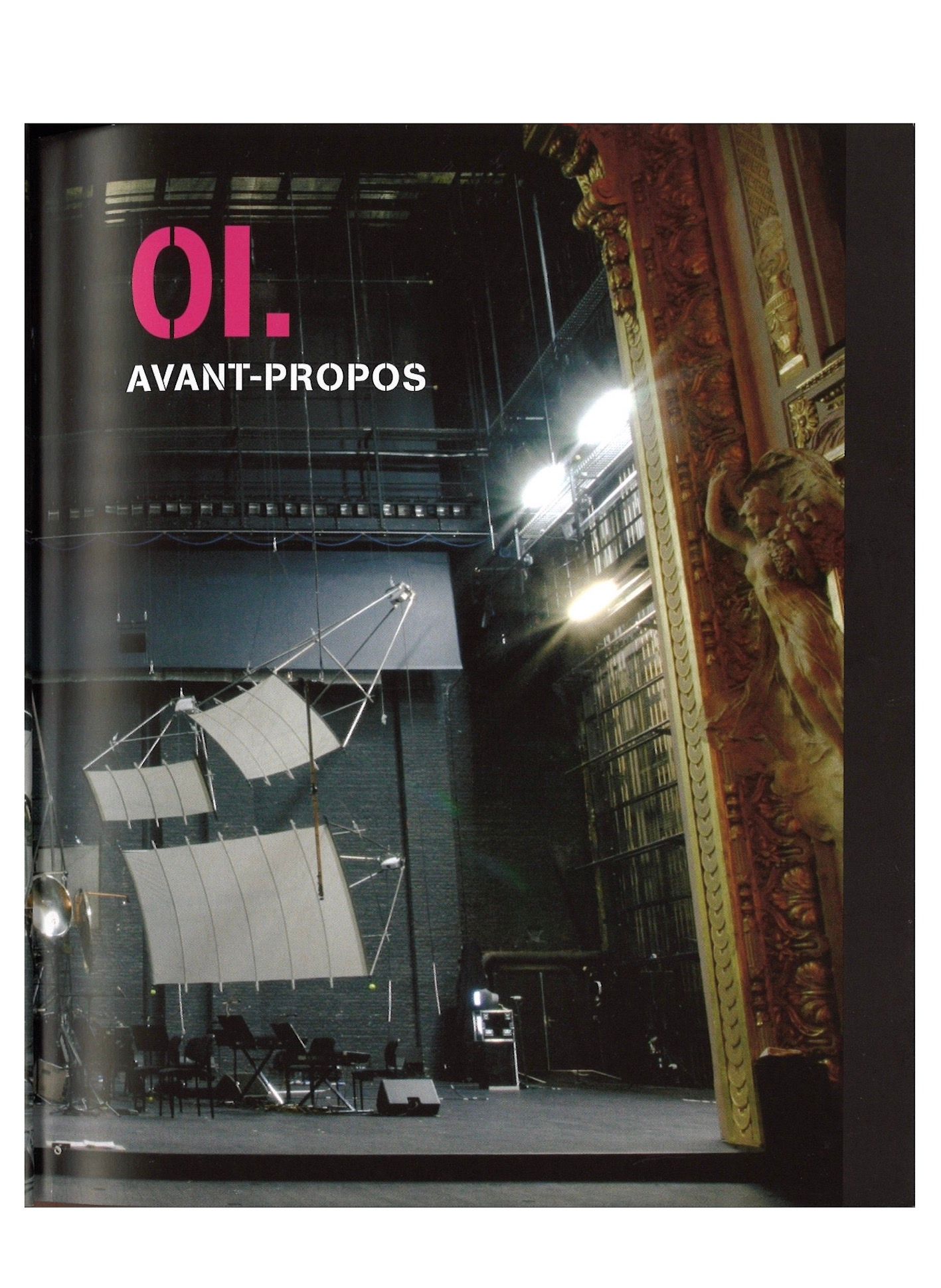
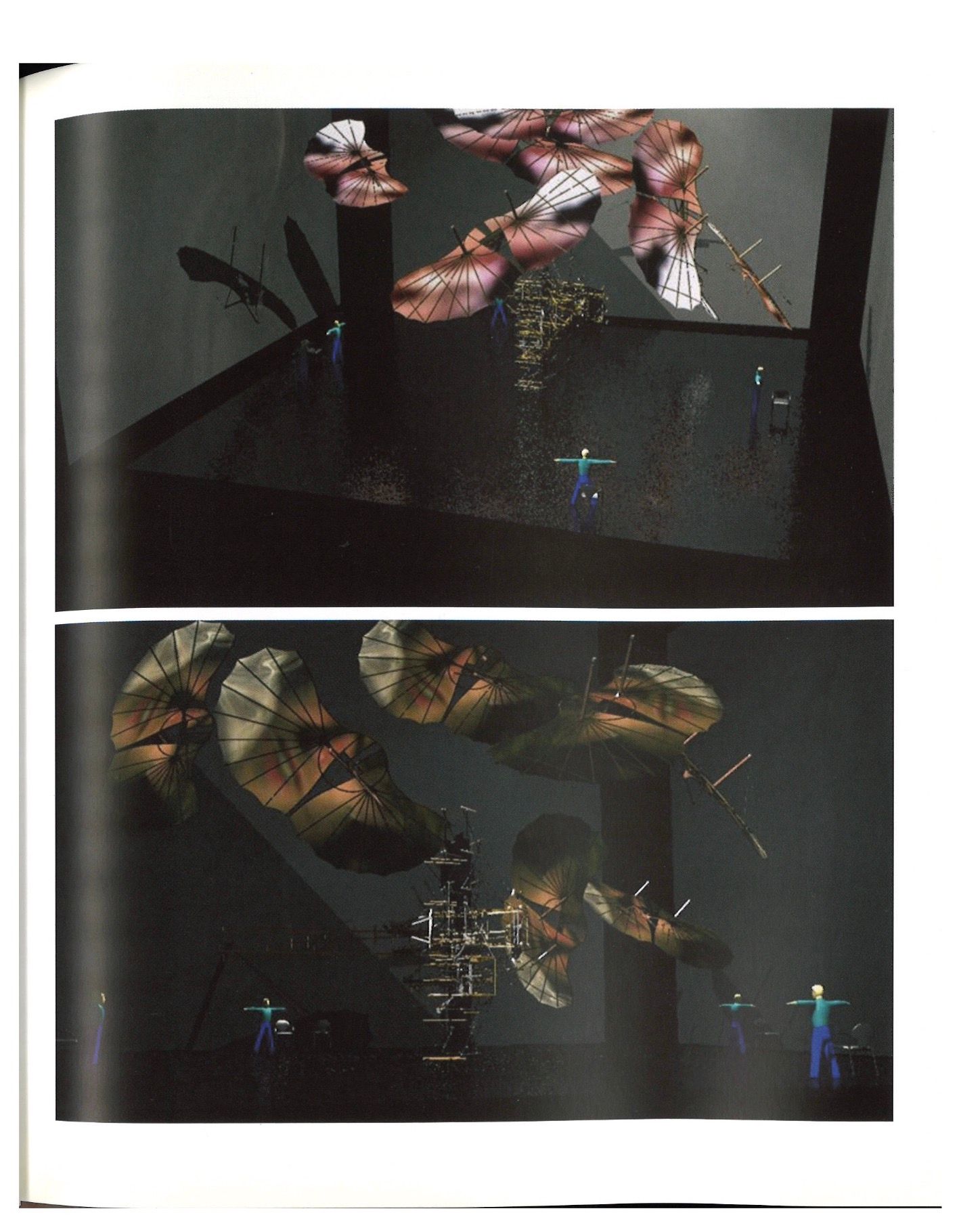
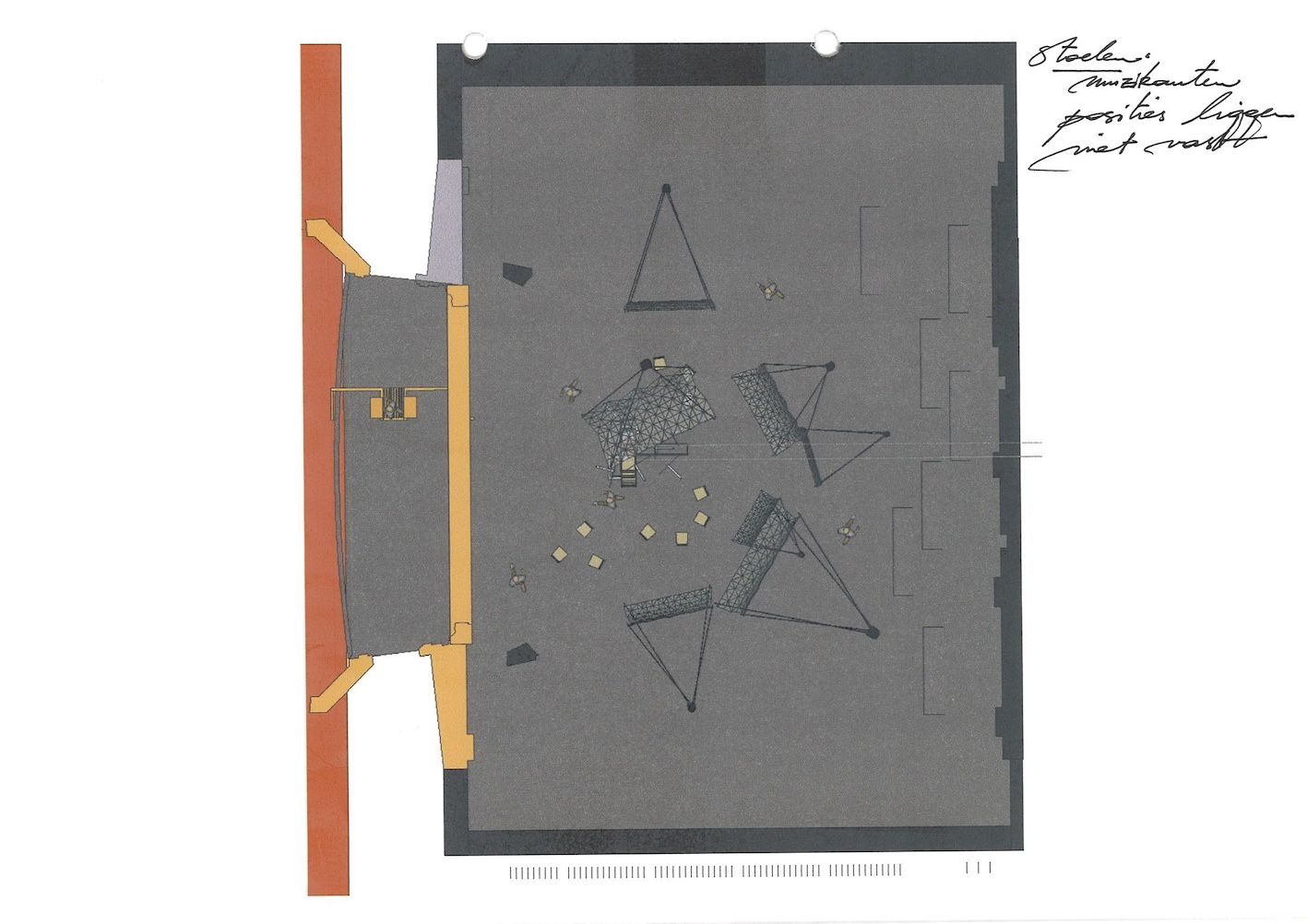
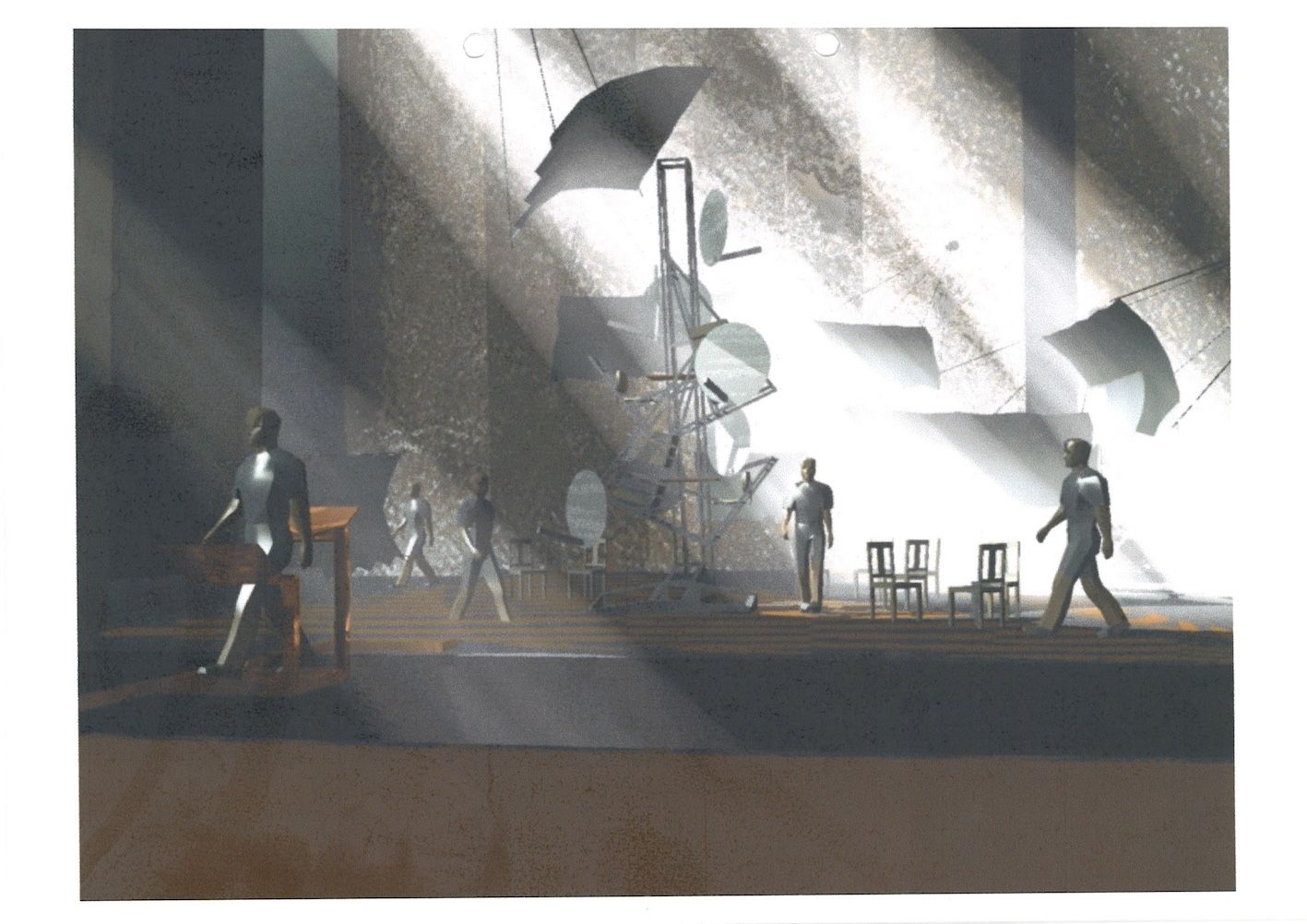
(PETER MISSOTTEN AND KURT D’HAESELEER) ..lightning-rod... for Avis de Tempête, we created a video installation above and around the singers and players, as though to protect them from a hostile world. Seven screens in a structure inspired by Benjamin Franklin’s kite hang about a great tower saturated with electronics. The tower resembles a lightning-rod but can equally put one in mind of a huge antenna fixing a reference point. Before World War I kites were used by the secret services; on the stage of Avis de Tempête, the hanging screens are like an echo of this practice, constituting a veritable ‘observation machine’ that records, from all possible angles, the acts and gestures of the performers. One after another the singers are forcibly projected as images in a multiplicity of virtual environments. The actions of the singers are as it were dictated by the video installation that surrounds them and which they inhabit.
(SÉBASTIEN ROUX) ...virus... the sound peculiar to digital error has also formed an area of exploration. The notion of the digital virus has already been explored by artistes such as Yasunao Tone, a former member of the Fluxus collectivity, which worked with the sounds produced by reading errors of a CD, by using prepared CDs (scratching the CDs, sellotape collage on the support). With Oval, from the early 1990s, this sound became known as the digital click (the sounds you hear when a CD jumps), the veritable signature of a musical movement called electronica. It seemed to me crucial to introduce this sound translation of digital error into instrument samplers, as if a virus had penetrated to the core of the sounds.
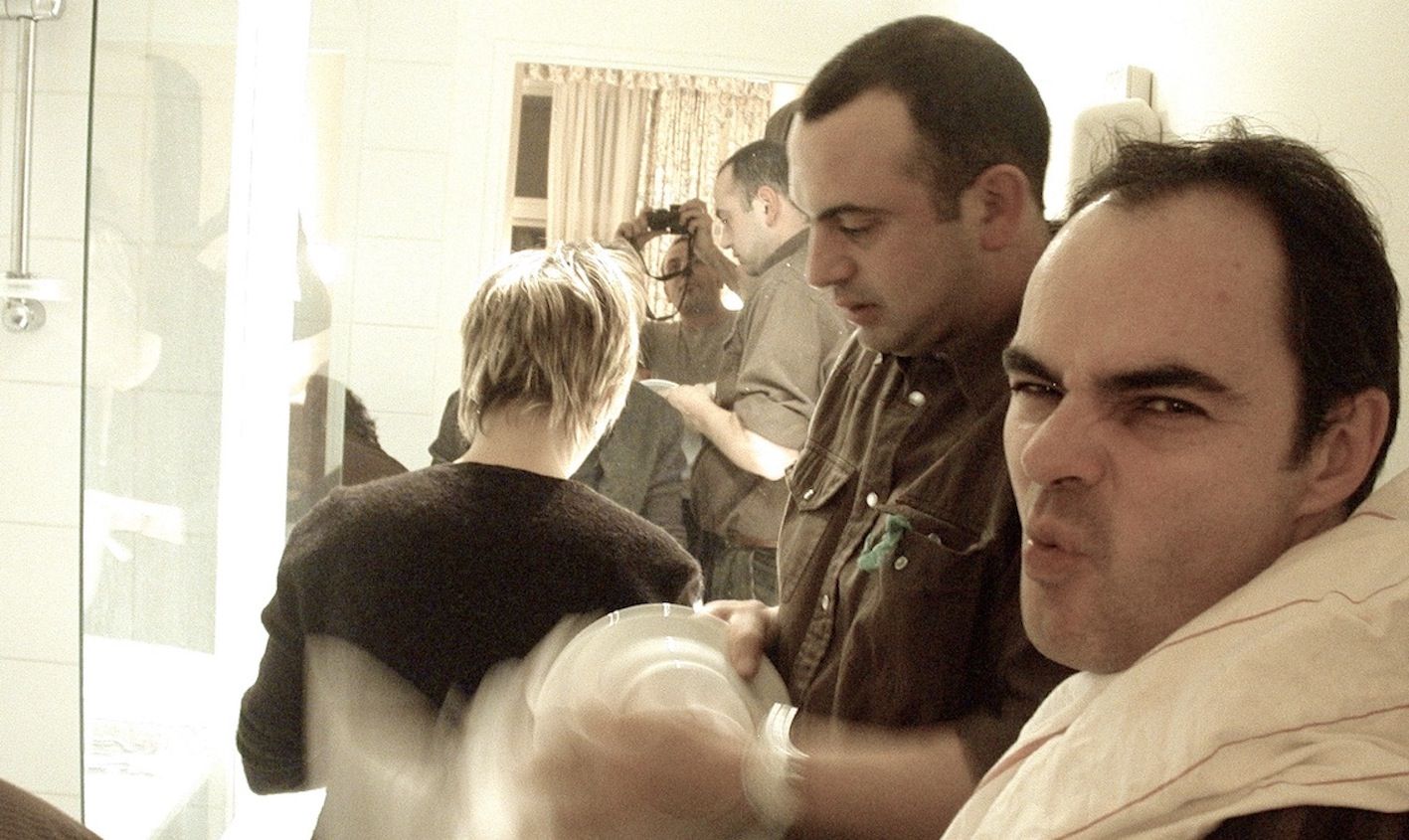
Infrared photographs
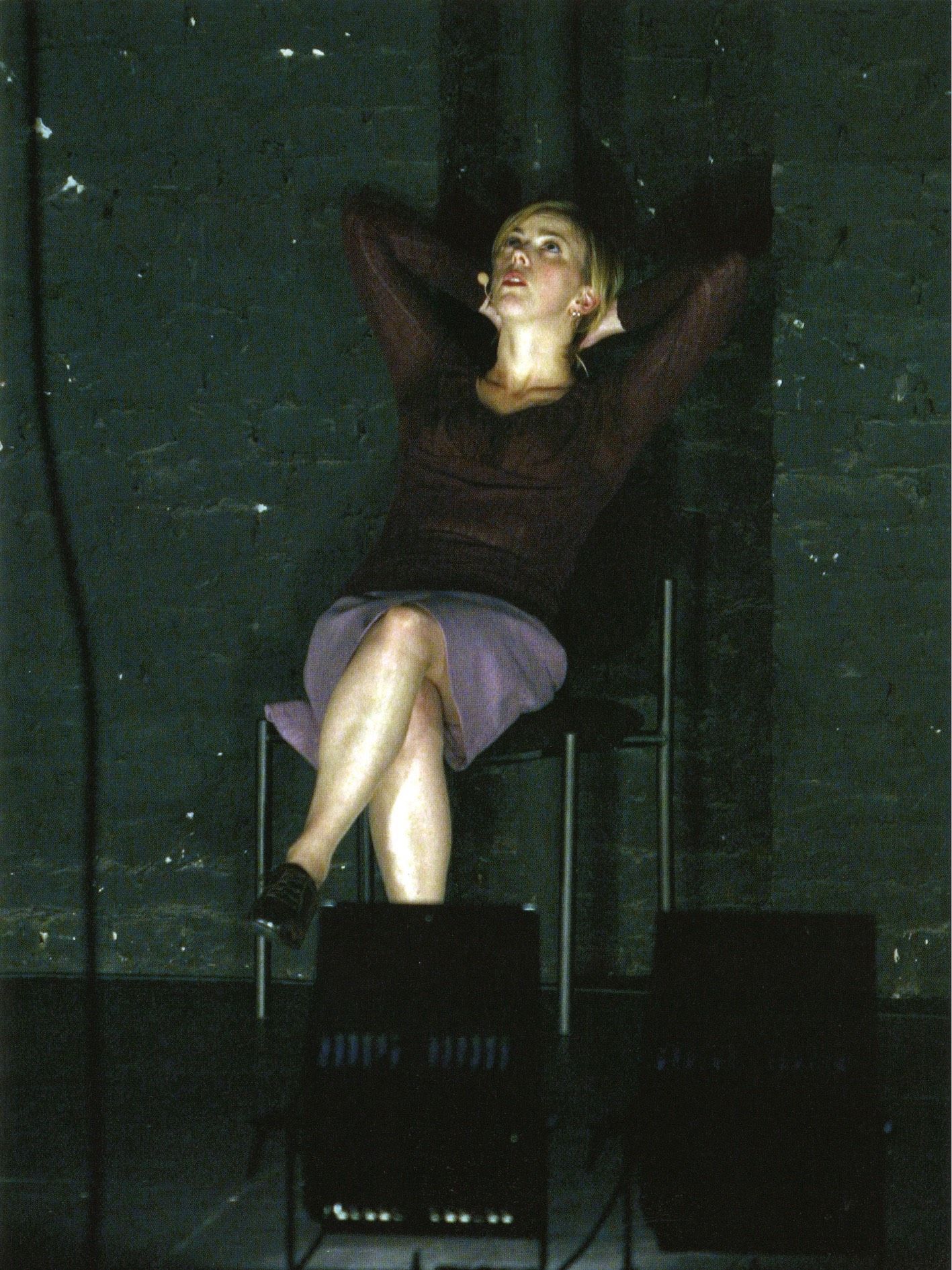
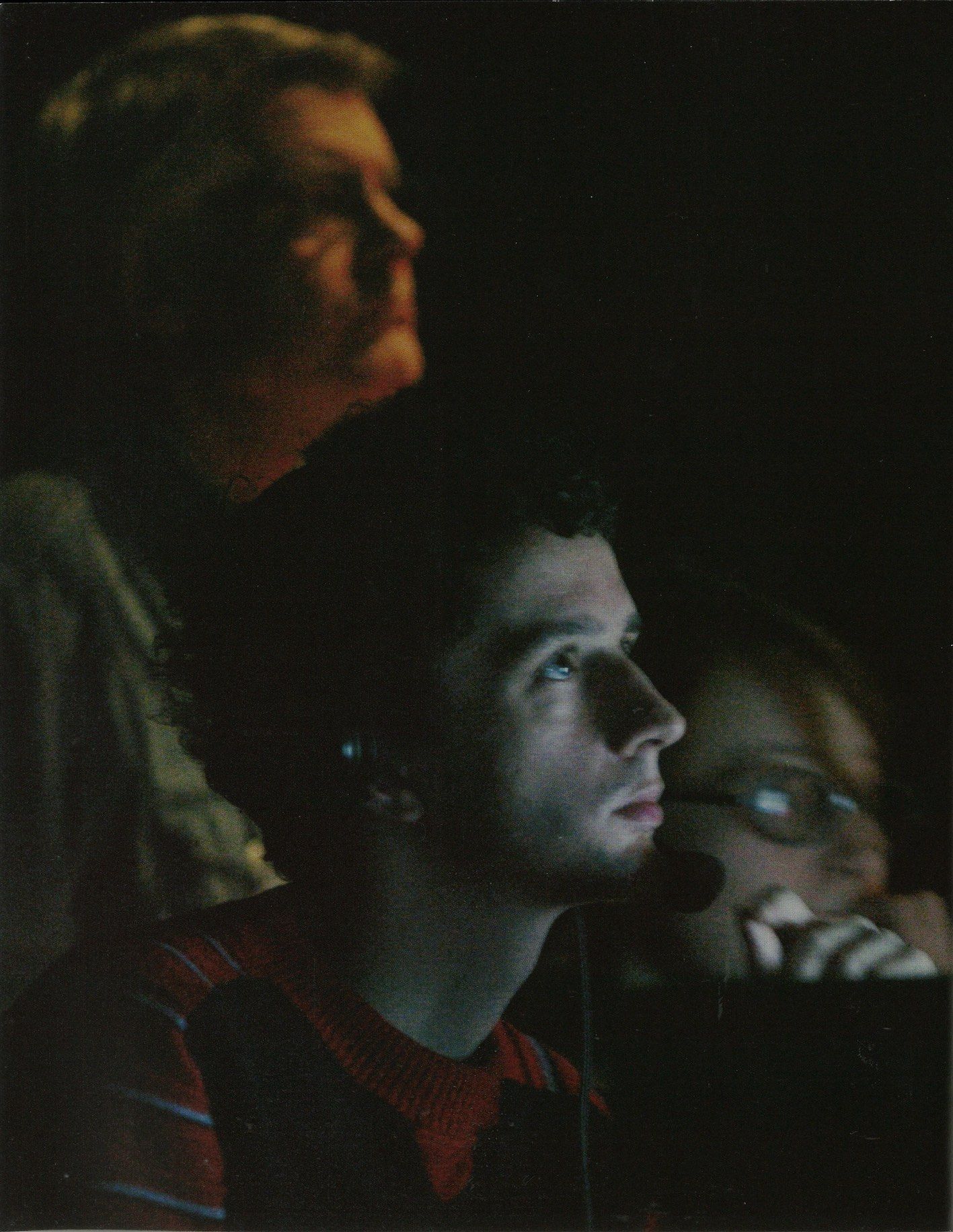
A series filmed in low light during rehearsals at the Lille Opera House in 2004.


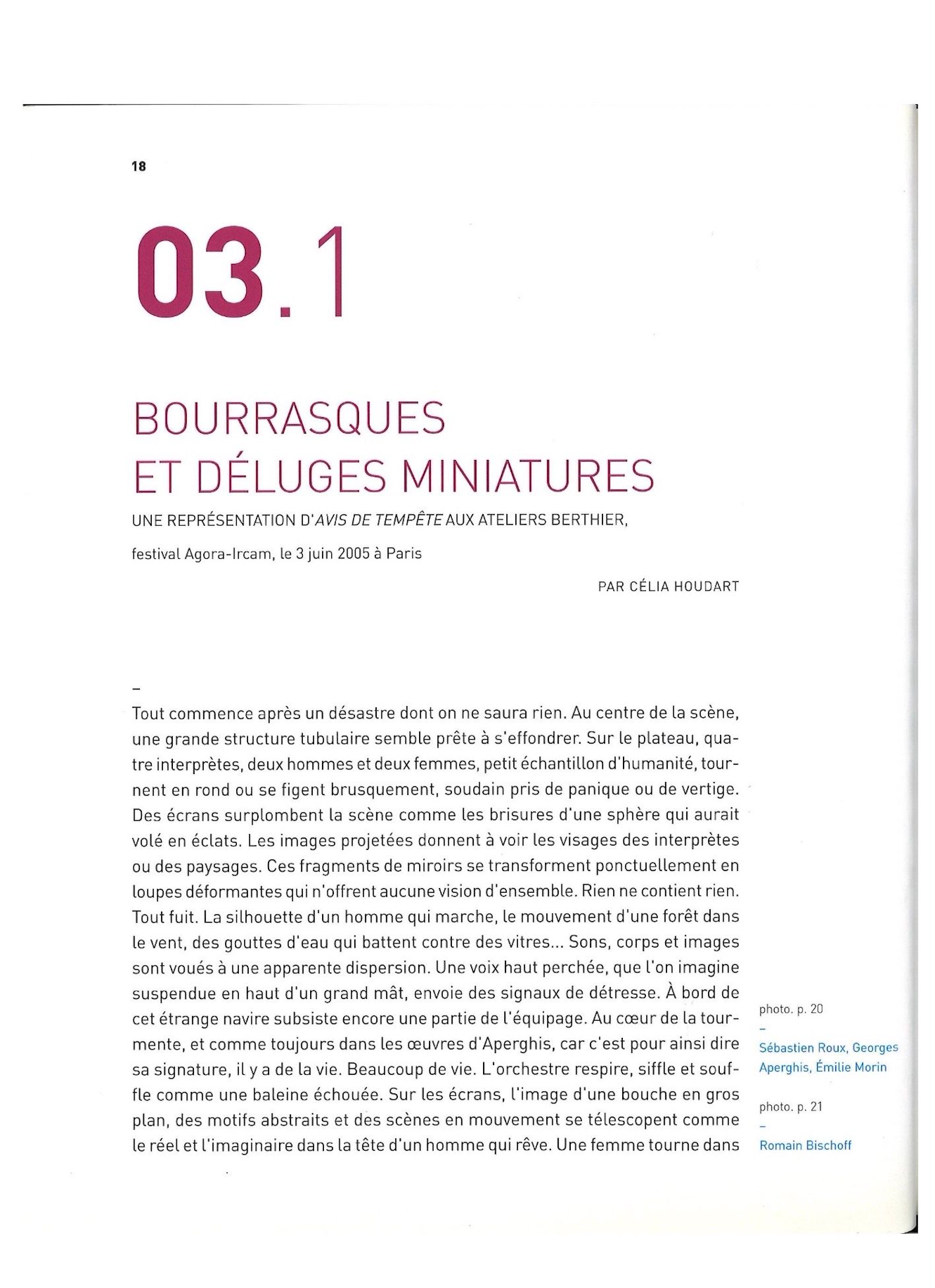
The view of Célia Houdart
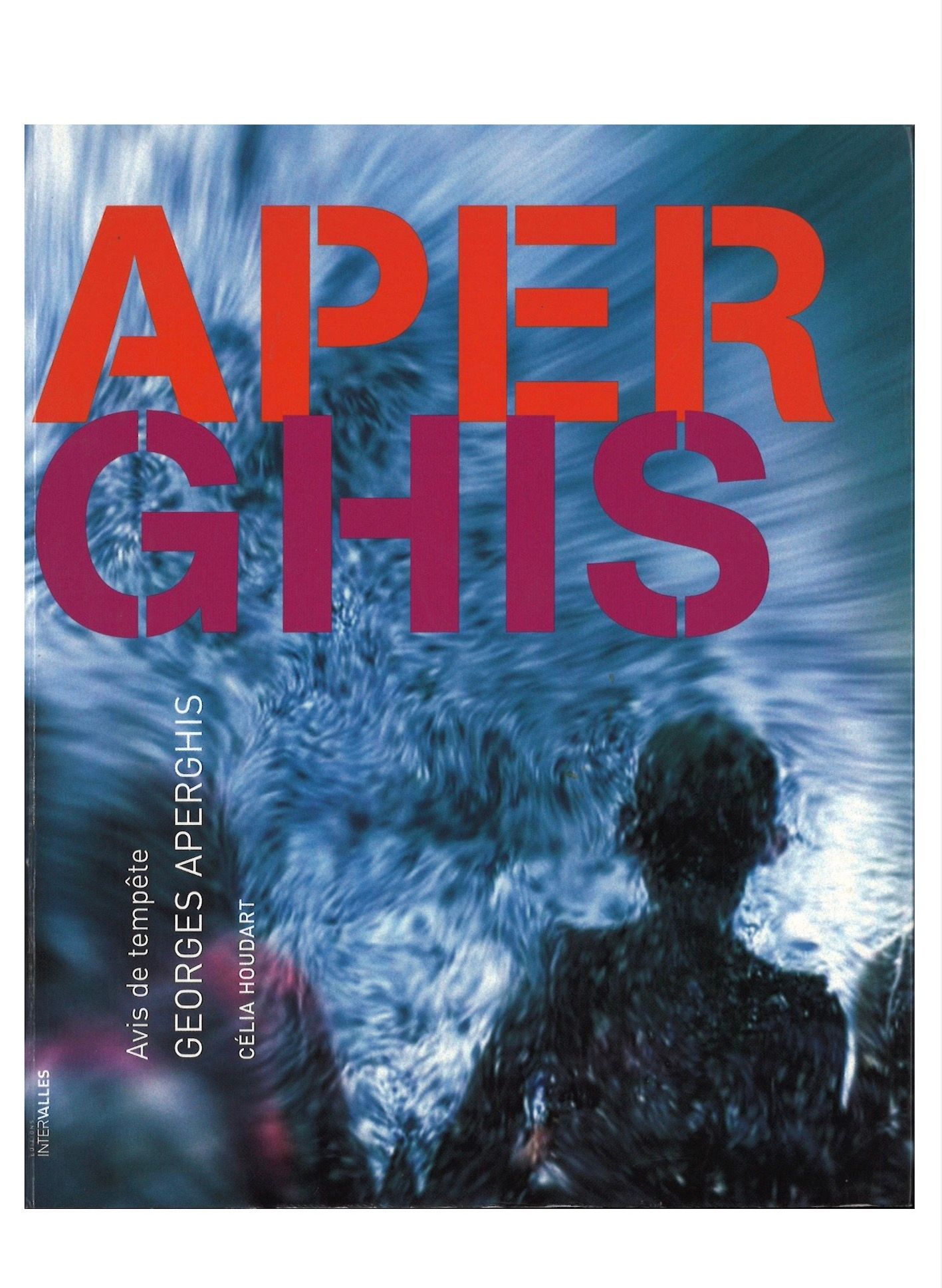
Alongside Catherine Maximoff's documentary (see the video clip above on this page), Célia Houdart has written a fascinating book about the genesis of Avis de Tempête, published by Intervalles. Georges Aperghis, his performers, and Célia herself explain step by step the different phases of the creation. A striking and warm personality in contemporary music, Georges proves to be an extraordinary teacher.
Reading Past Melville
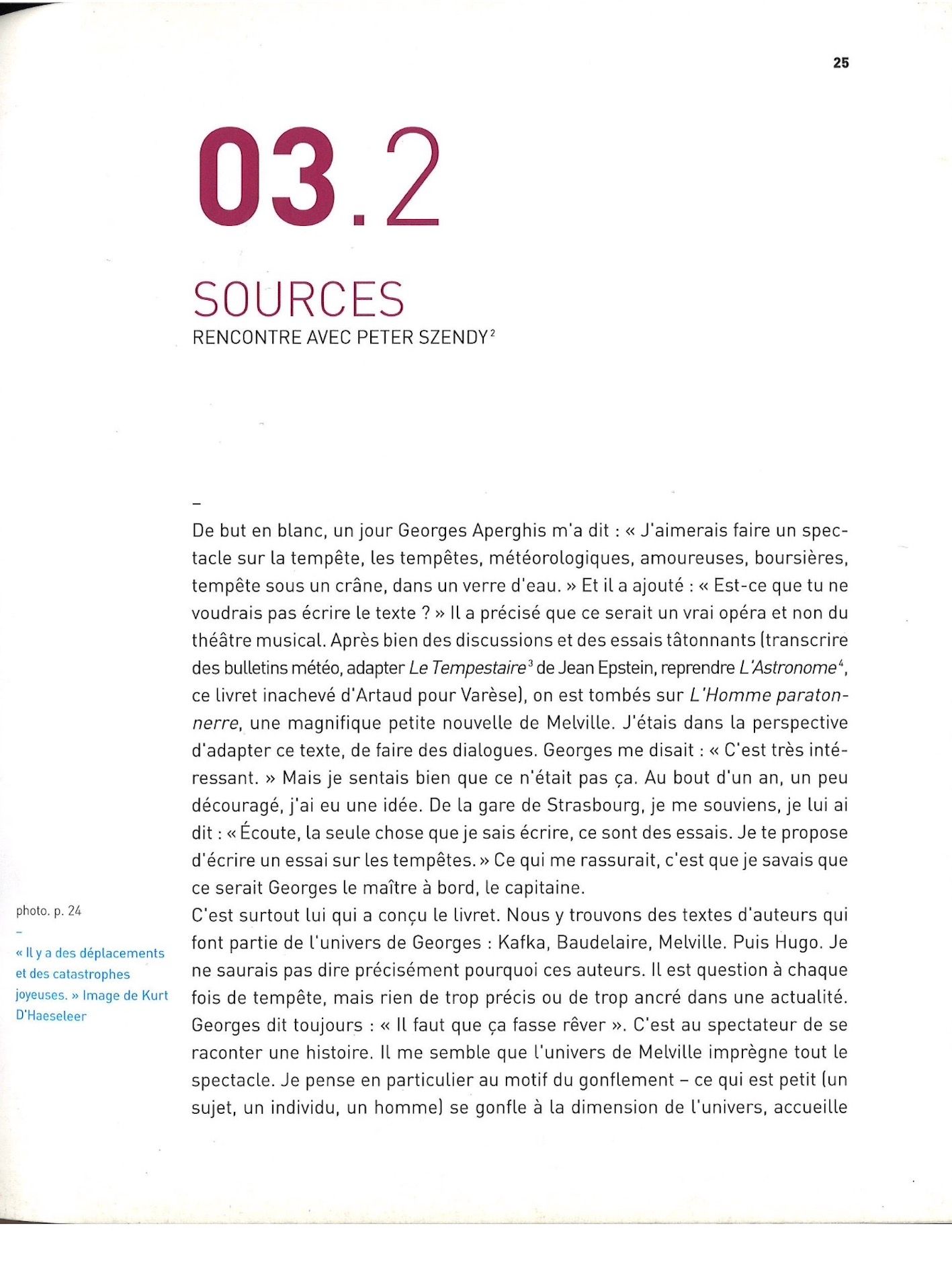
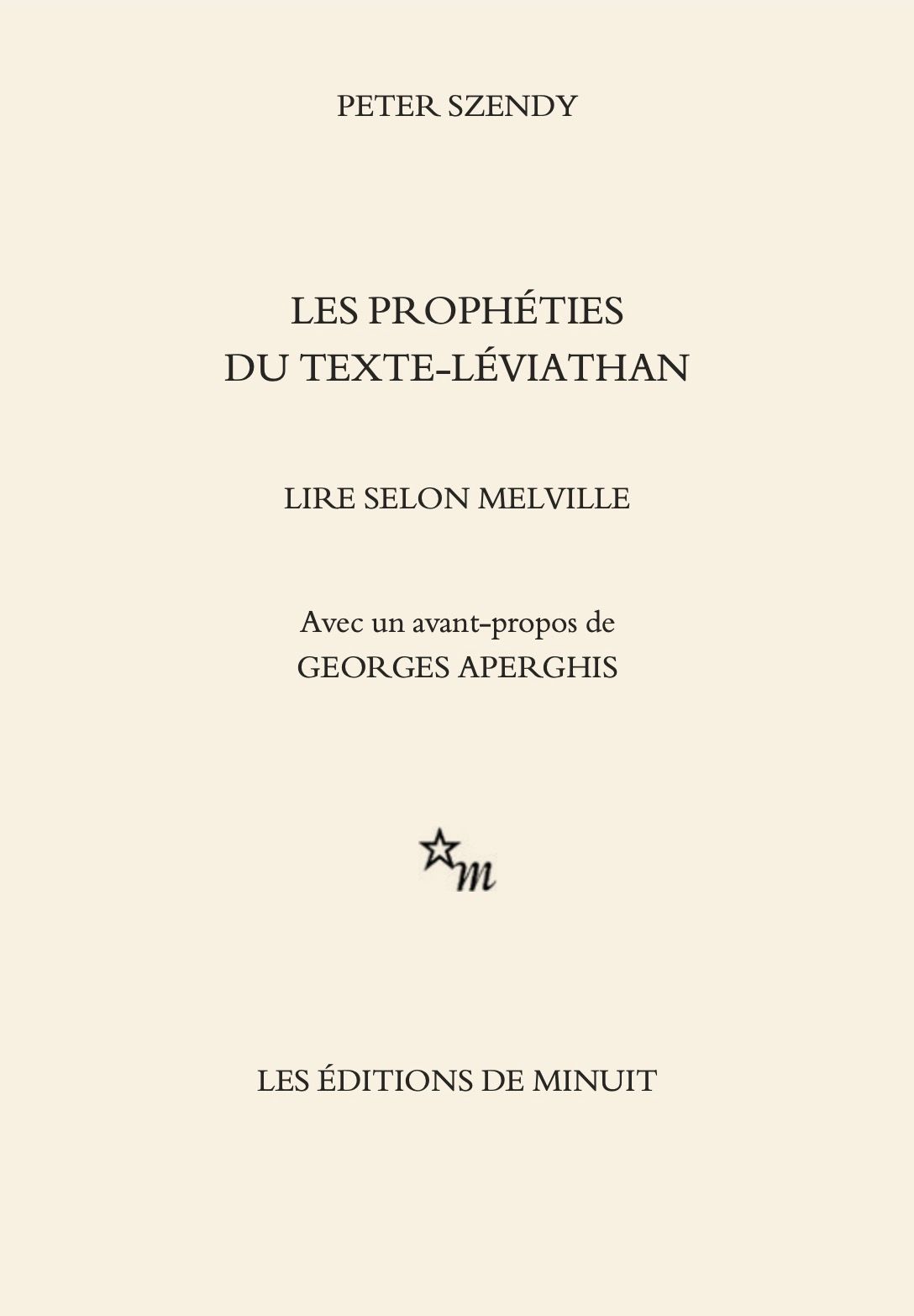
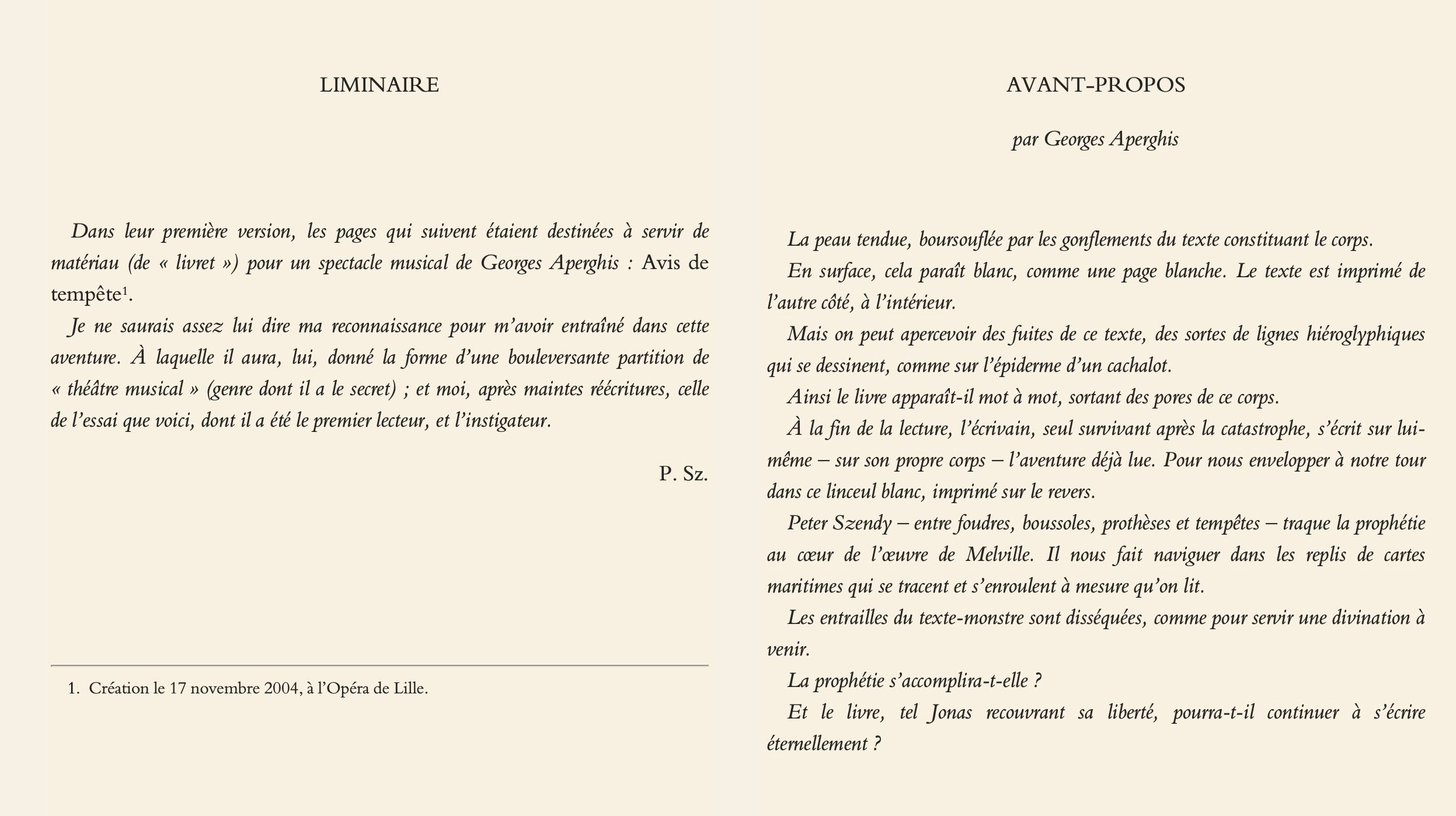
The “Avis de Tempête” adventure also led to an essay by Peter Szendy, Prophecies of Leviathan: Reading Past Melville, first published in French by Editions de Minuit, Les prophéties du texte-Léviathan: Lire selon Melville.
"Reading Melville is not only reading. Reading Melville means being already engaged in the abyssal process of reading reading. Reading what reading is and what reading does."
Memory box
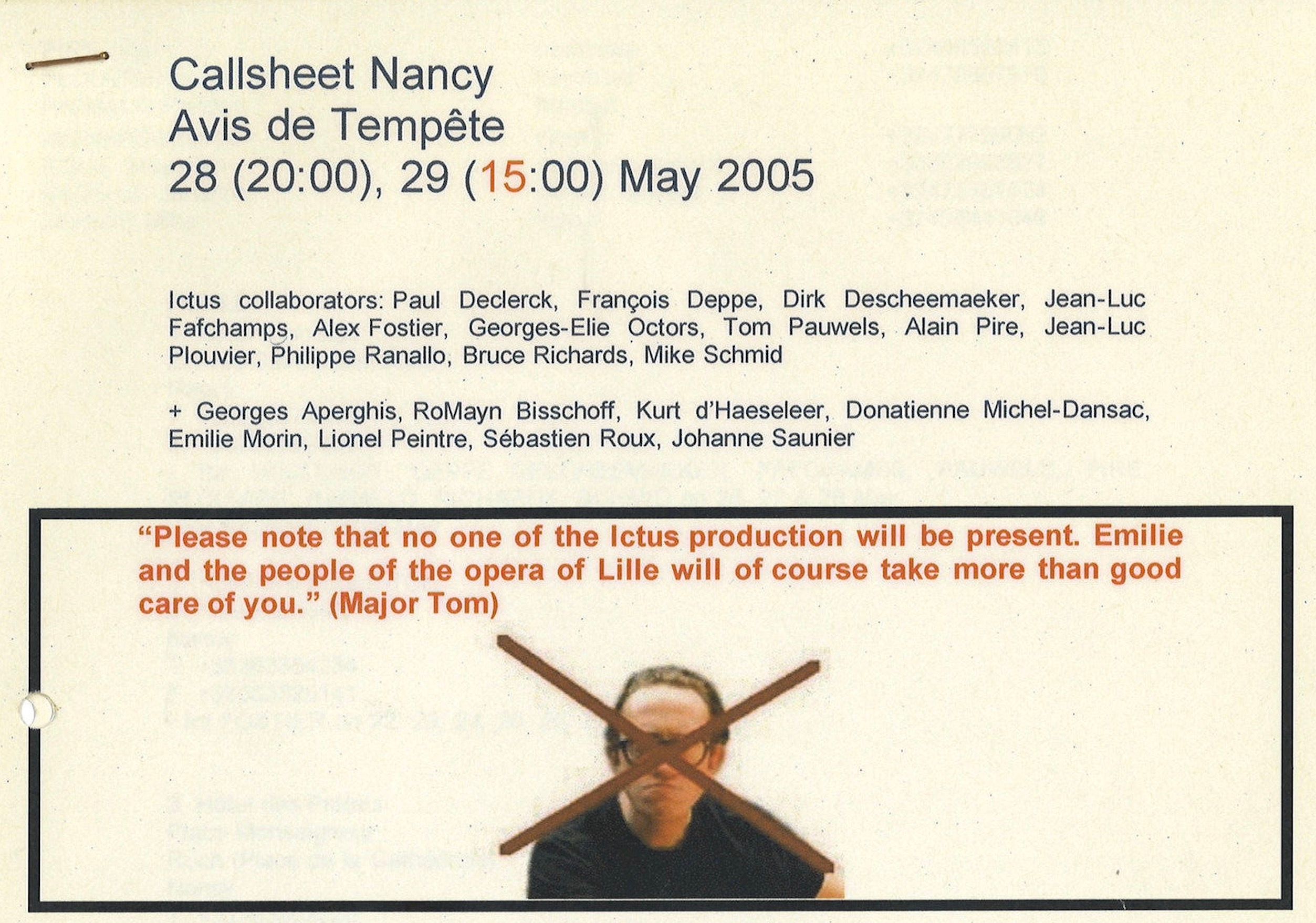
... declassified from the archives ...




Avis de Tempête
GALLERY
An opera by Georges Aperghis, 2004
Music and direction: Georges Aperghis
Libretto: Georges Aperghis and Peter Szendy, including fragments of texts by Herman Melville, Franz Kafka, Charles Baudelaire, William Shakespeare, Victor Hugo
Conductor: Georges-Elie Octors
Donatienne Michel-Dansac: soprano | Johanne Saunier: actress and dancer | Lionel Peintre: baritone | Romain Bischoff: baritone
Ictus — Kaatje Chiers: horn, Paul De Clerck: viola, François Deppe: cello, Dirk Descheemaeker: bass clarinet, Jean-Luc Fafchamps: keyboard; Tom Pauwels: electric guitar, Alain Pire: trombone, Jean-Luc Plouvier: keyboard, Philippe Ranallo: trumpet, Michael Schmid: flutes
Computer music design IRCAM: Sébastien Roux | Video: Kurt d’Haeseleer - de filmfabriek | Stage and light design: Peter Missotten -de filmfabriek | Music software: IRCAM | Sound: Alexandre Fostier | Direction assistant: Emilie Morin
Excerpt from the Kaaitheater program, 2007
One of the high points of last season was the performance of Georges Aperghis’ 14 Récitations by the French soprano Donatienne Michel-Dansac during the Performatik 3 festival. (...) Aperghis is joining us again this season, and again with Avis de tempête, according to Les Inrockuptibles a ‘miraculous, hallucinatory’ piece of musical theatre, first performed by Ictus at the Opéra de Lille in 2004. It was staged by Aperghis himself. Both on stage and in his score, Aperghis unleashes a storm that sweeps away everything in its path. In the script he mixes Melville’s Moby Dick with extracts from Kafka, Baudelaire, Shakespeare and Victor Hugo. But, just as in the 14 Récitations, the words are not set to music, the words are music. The words intensify the musical high. For the singers it is a tour de force in which they are assisted by ten musicians and the ingenious use of video and stage setting (created by the FilmFabriek).
In this opera, singing, acting, music, electronics, video, light and stage set are forged into a single whole. As Le Figaro put it: ‘It is the perfect combination of all means of expression that makes Avis de Tempête a total work of art."
Score follower
This video has been edited from the original personal score of Georges-Elie Octors.
Avis de tempête: libretto, credits, video & notes
The booklet is available on our website at this address
Full credits and CD sleeve notes are available on this page.
For documentary purposes, the full video of the concert (low quality) is available here
"Aperghis, tempête sous un crâne"
Documentary directed by Catherine Maximoff
Aperghis, tempête sous un crâne (Storm Beneath a Skull)
Documentary directed by Catherine Maximoff
Written by Patrice Nezan and Catherine Maximoff
Episode specifically dedicated to Avis de tempête at 39:42
Video from the Vimeo page of the director.
France • 2006 • 59 minutes
Les Films du présent
From the CD booklet
Before writing a single note of his opera Avis de Tempête (Storm Warning), Georges Aperghis had given the watchword to his collaborators, the librettist, the video artists, the singers, the computer technician, the conductor, the scenographer and the musicians: “an opera that is a storm”. Here are a few fragments of what has been noted down since then.
(GEORGES APERGHIS) ...storms... Construct – relate. Then disturb – erase. Storm in the mind, in the text, in the music. The instruments, the voices, the electronic sounds write, erase, write, erase, in turn, like some vast breathing process. Like a story forever beginning again. The main part of the spectacle troubled by internal disturbances. Moby Dick, King Lear, The Lightning-Rod Man: allegories of the mental storm that rips through the text and subverts the spectacle from within. Immobile storms too. A kind of novelty of our century. Vertical storms – almost calm – much more terrifying than countryside thunder.
(SÉBASTIEN ROUX) ...electronic cut-ups... When Georges Aperghis tackled the theme of dysfunction, of the virus – allegories of the storm – and knowing of his work on the voice and on words, I at once thought of the process of cut-up. This technique, made famous by the American writer William S. Burroughs (whose voice appears in one sequence!), had been developed by the latter and by Brion Gysin. The cut-up consists of reordering a text by cutting it up into fragments and randomly linking these fragments together again with the aim of revealing or giving new meanings to the text. How can a cut-up be effected with the tools of computing? The most pertinent process seemed to me that of granular synthesis, the theoretical foundation of which has been established by the researcher and composer Curtis Roads. This technique entails cutting up a sound sample into fragments that last a matter of milliseconds, the so-called grains. These grains are then randomly reordered to form a complex sound object. By extending the size of the grains to one second, the granular synthesis becomes a fully fledged compositional tool, a truly digital cut-up.
(PETER SZENDY) ...whale-text... What could I answer when he said to me (it was three years ago) that he would like something for a forthcoming spectacle on the storm? On the storms, all storms? And how did that word canvas come about, the one we have become accustomed to calling, between ourselves, our whale-text? As regards my contribution (before he reintroduced loops, repetitions, sculpted syllables and phonemes, even scattered fragments of texts garnered from here and there, from Kafka, Shakespeare et al.), here is what happened. Like Sheherazade, for whom the future depended on a continuing succession of stories, a voice – that of a narrator – speaks to you. This voice does not invent fiction with which it tries to converse with you and hold you: it manipulates it, it borrows it (mainly from Melville) and it adds endless commentaries. It reiterates its glosses, all of which deal with reading, with the act of reading as an opening out to a prophecy or to a future promise, like exposure to an improbable, unpredictable and ‘unprereadable’ event, the figure of which is the storm and its various forms (thunder storm, cyclone, flood, etc.).
(GEORGES APERGHIS) ...from one world to another... Fluids, sounds, images, information: they all pass through us and it becomes very difficult to focus on any one thing. Electronics enables me to realise this state of perpetual transition, to jump from one world to another. An abstract sound becomes the voice of an actor, a phoneme becomes running water, a character may be divided up and then reconstructed elsewhere. I work on two electronic worlds, a harmonic world built on distorted octaves and a world of very low level noises progressively amplified until they swamp everything. The electronics is there to destabilise the ensemble but also to sweep it away as a real storm would, to outstrip it, to catch it unawares. Compared with the storm everything becomes small and ridiculous.
(PETER SZENDY) ...in the flood... Among the fragments read, interpreted and translated by this voice, two narratives by Melville act as golden threads that crisscross as they interact and entwine each other: the short story entitled The Lightning-Rod Man and the great novel Moby Dick. In the story, the one who speaks and who says “I” holds not only the text of an unfolding storm, but also, within himself, a focus of intrusion that flows back towards him and enrages him: dislodged in the deluge. From the novel, on the other hand, come many scenes representing a reading of the novel as a drifting, a loss of anchorage, a splitting, in which, paradoxically, prediction and presage are achieved by breaking the horizons of expectancy, to the point that, since everything has already happened and there is nothing more to verify, the event seems to have free range: it starts up again, as if the Leviathantext, infinitely reworked and glossed, had let a bubble escape from itself. The result is repetition, that is to say the unheard of.
(GEORGES-ÉLIE OCTORS) ...to be grasped... An incredible characteristic of Georges Aperghis’s works, and one that is ever a surprise, is the contrast between the limpidity of the score and the lively, organic profusion of the musical result. In opening a score by Georges, you feel you can smell the wooden desk at which it was patiently written, note by note, in his tight, fastidious hand. The simplicity, the transparency, the rigor might have presented the performer with frightful constraints; but nothing of the kind: the score is laid out in such a way that the musician can grasp it as a whole, and everything motivates him to give it life. And the basic reason for this is that his style, even at its most idiomatically instrumental, is first and foremost and fundamentally vocal.
(SÉBASTIEN ROUX) ...spectrums and skeletons... this opera is a mixed work, comprising an acoustic part for instruments and voices and an electronic part. This latter consists of sequences, the development of which preceded the instrumental score which thus came to be enriched with the electronic material. The sequences, set off in the course of the work, act like punctuation marks in the score, like a counterpoint to the orchestra as touching both tone-colour and space. With a view to translating the storm of the mind through the electronic medium, Georges Aperghis’s idea was to apply to samples of instruments or voices transformations able to indicate dysfunction. Georges thus established a list of themes for research, poetic evocations of algorithms: virus, skeleton, tone-colour enrichment, the notion of vertical, of octave, of harmonic add-on. I based myself on this vocabulary in order to make some computer tools, storm machines, a personal interpretation of the main lines proposed by Georges Aperghis.
(PETER MISSOTTEN AND KURT D’HAESELEER) ..lightning-rod... for Avis de Tempête, we created a video installation above and around the singers and players, as though to protect them from a hostile world. Seven screens in a structure inspired by Benjamin Franklin’s kite hang about a great tower saturated with electronics. The tower resembles a lightning-rod but can equally put one in mind of a huge antenna fixing a reference point. Before World War I kites were used by the secret services; on the stage of Avis de Tempête, the hanging screens are like an echo of this practice, constituting a veritable ‘observation machine’ that records, from all possible angles, the acts and gestures of the performers. One after another the singers are forcibly projected as images in a multiplicity of virtual environments. The actions of the singers are as it were dictated by the video installation that surrounds them and which they inhabit.
(SÉBASTIEN ROUX) ...virus... the sound peculiar to digital error has also formed an area of exploration. The notion of the digital virus has already been explored by artistes such as Yasunao Tone, a former member of the Fluxus collectivity, which worked with the sounds produced by reading errors of a CD, by using prepared CDs (scratching the CDs, sellotape collage on the support). With Oval, from the early 1990s, this sound became known as the digital click (the sounds you hear when a CD jumps), the veritable signature of a musical movement called electronica. It seemed to me crucial to introduce this sound translation of digital error into instrument samplers, as if a virus had penetrated to the core of the sounds.
Infrared photographs
A series filmed in low light during rehearsals at the Lille Opera House in 2004.
The view of Célia Houdart
Alongside Catherine Maximoff's documentary (see the video clip above on this page), Célia Houdart has written a fascinating book about the genesis of Avis de Tempête, published by Intervalles. Georges Aperghis, his performers, and Célia herself explain step by step the different phases of the creation. A striking and warm personality in contemporary music, Georges proves to be an extraordinary teacher.
Reading Past Melville
The “Avis de Tempête” adventure also led to an essay by Peter Szendy, Prophecies of Leviathan: Reading Past Melville, first published in French by Editions de Minuit, Les prophéties du texte-Léviathan: Lire selon Melville.
"Reading Melville is not only reading. Reading Melville means being already engaged in the abyssal process of reading reading. Reading what reading is and what reading does."
Memory box
... declassified from the archives ...